Mercer Culinary is the brand many cooks meet in their first knife roll. It sells a long list of series at modest prices, and the names don’t tell you much. Genesis and Millennia can look similar on a screen and are not the same kind of knife at all.
This guide assumes you have already chosen Mercer and want to know which one. It names eight different knives across five series, says which buyer each one suits, and says when another brand would be the better choice.
Julia’s earns a commission on purchases made through links on this page, at no cost to you. Recommendations are based on what a restaurant kitchen looks for, product specifications, makers’ statements and the independent sources we name. We have not used these products ourselves.
Quick verdict: which Mercer knife to buy
Buy the Mercer Genesis 8-inch Chef’s Knife if this knife needs to last. It is forged from German steel and had the sharper new edge in The Rational Kitchen’s measurement. Choose the Mercer Millennia 8-inch Chef’s Knife if you are a student or want a low-cost knife to learn on, and accept that it needs frequent honing.
Five Mercer knives at a glance
Five picks side by side, one for each kind of buyer. All eight knives are reviewed below.
| Knife | Best for | Build | Type | Buy on Amazon |
|---|---|---|---|---|

Mercer Genesis 8-inch Chef’s KnifeBest overall
|
Long-term all-rounder | Forged, German steel | 8-inch chef | View on Amazon |
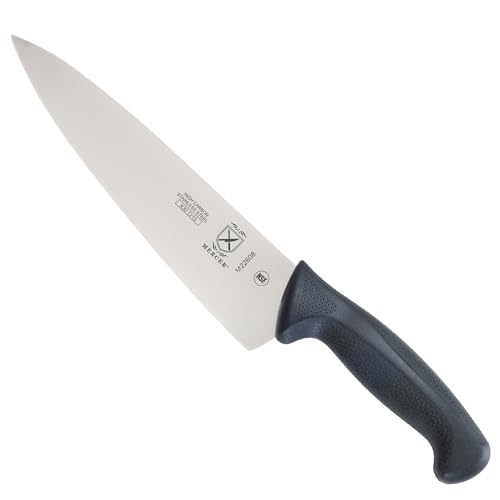
Mercer Millennia 8-inch Chef’s KnifeBudget pick
|
Students and first knives | Stamped, Japanese steel | 8-inch chef | View on Amazon |

Mercer Renaissance 7-inch SantokuBest santoku
|
Straight chopping | Forged, German steel | 7-inch santoku | View on Amazon |

Mercer Genesis 3.5-inch Paring KnifeBest paring knife
|
Seeding, trimming, peeling | Forged, German steel | 3.5-inch paring | View on Amazon |

Mercer BPX 5.9-inch Curved Boning KnifeBest boning knife
|
Chicken, pork, trimming | Semi-flexible, German steel | 5.9-inch boning | View on Amazon |
Product images from Amazon. Build details come from the listings and the reviewers named in each pick.
Our picks for the best Mercer knives
The picks follow the order most cooks should buy in: chef knife first, then a santoku or paring knife, then the specialist blades. They are different models rather than color variations of one knife.
1. Mercer Genesis 8-inch Chef’s Knife – Forged Blade, Grippy Handle
Genesis is the Mercer line to buy if you want one knife for years rather than one for a term of culinary school. The listing describes a precision-forged high-carbon German steel blade with a taper-ground edge and a non-slip handle meant to stay secure with wet hands.
The Rational Kitchen measured the 8-inch knife with a professional edge tester and got a sharper new-out-of-the-box reading than it got from the Millennia, and it complained mainly that the knife is on the heavy side and that the square spine can become uncomfortable after about half an hour. For chopping a big pile of onions and peppers that is a fair warning: try a pinch grip early and see how the spine sits on your finger.
Why we like it
- Forged German X50CrMoV15 steel, per The Rational Kitchen and Prudent Reviews
- Sharper out of the box than Millennia in The Rational Kitchen’s edge test
- Non-slip handle, per the listing
- Lifetime warranty stated on the listing
Key specifications
| Model | M20608 |
|---|---|
| Series | Genesis |
| Blade | 8-inch chef |
| Construction | Forged |
| Steel | German X50CrMoV15 (reviews) |
| Handle | Santoprene (Prudent Reviews) |
| Care | Hand wash, no dishwasher (listing) |
| Warranty | Lifetime (listing) |
Why we recommend it
It suits a home cook or student who wants forged weight and a grippy handle. It is a better long-term buy than the stamped school knife below.
Skip it if you want a light knife. The Rational Kitchen’s main complaint was weight, and the Millennia is the obvious lighter option.
Pros and cons
Pros
- Forged blade
- Strong new edge in one independent test
- Grippy handle
Cons
- Heavy for some hands
- Square spine can rub after a long session
- No dishwasher
2. Mercer Millennia 8-inch Chef’s Knife – The Culinary School Workhorse
Millennia is the stamped Mercer knife many students meet first. The Rational Kitchen says many young chefs still use Mercer knives because that is what they learned on in culinary school, and that the company began by supplying culinary schools and food service, though that is a statement about the brand rather than about this exact knife.
Be clear on the trade-offs. Prudent Reviews and The Rational Kitchen both list it as stamped from X30Cr13 steel. The Rational Kitchen calls the steel soft, says it needs frequent honing and sharpening, and rates fit and finish as mediocre, with some rough edges and an uncomfortable spine. Prudent Reviews says Millennia gets the most balance complaints in the range. It is a tool you use hard and resharpen often, and at that it is a sensible first knife.
Why we like it
- Stamped, one-piece blade, per the listing
- Textured finger points on the handle, per the listing
- Common among students and young cooks, per The Rational Kitchen
- Repair or replacement promise stated on the listing
Key specifications
| Model | M22608 |
|---|---|
| Series | Millennia |
| Blade | 8-inch chef |
| Construction | Stamped |
| Steel | Japanese X30Cr13 (reviews) |
| Handle | Santoprene and polypropylene (Prudent Reviews) |
| Care | Hand wash, no dishwasher (listing) |
| Warranty | Repair or replace if defective (listing) |
Why we recommend it
It suits culinary students, new cooks and a beat-around kitchen knife you do not mind sharpening often.
Skip it if you want one knife to last for years with little care. Soft steel means you will need to hone it regularly.
Pros and cons
Pros
- Simple, light tool
- Grippy textured handle
- Good way to learn to sharpen
Cons
- Soft steel needs frequent honing
- Mediocre fit and finish in one independent test
- Balance complaints
3. Mercer Renaissance 7-inch Santoku – Rounded Spine, Traditional Rivets
The Renaissance line takes the same forged German steel as Genesis and fits it with a traditional triple-riveted handle. The Rational Kitchen says it has the same steel and hardness rating as Genesis, and the listing highlights a rounded spine, which answers the most common complaint about the Genesis.
A 7-inch santoku suits straight chopping of onions, herbs and peppers. Prudent Reviews reports that Good Housekeeping named the Renaissance 8-inch chef knife its sturdiest chef’s knife, though that was secondhand for us and for a different blade shape. The santoku here is the same series in the shape we think most home cooks will use it for.
Why we like it
- Forged German steel, per the listing
- Triple-riveted handle and rounded spine, per the listing
- Same steel and hardness as Genesis, per The Rational Kitchen
Key specifications
| Model | M23590 |
|---|---|
| Series | Renaissance |
| Blade | 7-inch santoku |
| Construction | Forged |
| Steel | German X50CrMoV15 (reviews) |
| Handle | Delrin, triple riveted (Prudent Reviews, listing) |
| Care | Hand wash, no dishwasher (listing) |
| Warranty | Lifetime limited (listing) |
Why we recommend it
It suits a cook who prefers a straight chop and a traditional riveted handle to the grippy Genesis feel.
Skip it if you want a rocking cut. A curved chef knife suits that better.
Pros and cons
Pros
- Rounded spine
- Traditional rivets
- Forged blade
Cons
- No independent test of the santoku we could read
- No dishwasher
4. Mercer Genesis 3.5-inch Paring Knife – Same Grip in a Small Blade
A paring knife is what you use for seeding jalapeños, trimming beans and deveining shrimp, and the listing names exactly those jobs. Genesis carries its forged blade and non-slip handle down to 3.5 inches.
The grippy handle matters more on a small knife, because you often work over a bowl with wet hands. As with the rest of the line, keep it out of the dishwasher and dry it after washing.
Why we like it
- Forged high-carbon German steel, per the listing
- Non-slip handle, per the listing
- 3.5-inch blade for detail work
Key specifications
| Model | M20003 |
|---|---|
| Series | Genesis |
| Blade | 3.5-inch paring |
| Construction | Forged |
| Steel | German X50CrMoV15 (reviews) |
| Handle | Santoprene (Prudent Reviews) |
| Care | Hand wash, no dishwasher (listing) |
| Warranty | Lifetime limited (listing) |
Why we recommend it
It suits anyone who bought the Genesis chef knife, and anyone who works with chiles and small fruit most days.
Skip it if you only peel now and then. A thin stamped paring knife does that for less.
Pros and cons
Pros
- Secure with wet hands
- Forged
- Good small size
Cons
- Bulkier than a stamped paring knife
- No dishwasher

5. Mercer Genesis 8-inch Bread Knife – Wavy Edge for Crust and Skin

The listing describes a wavy edge for getting through crust or skin without tearing the soft inside, and names bread, angel food cake, meatloaf, fruit and tomatoes. For a kitchen that buys bolillos for tortas, that covers the job.
Eight inches is short for a big round loaf, so measure what you actually bake or buy. For rolls and sandwich loaves it has reach enough, and the same non-slip handle keeps a sawing stroke secure.
Why we like it
- Wavy edge, per the listing
- Forged German steel, per the listing
- Handles bread, tomatoes and soft fruit, per the listing
Key specifications
| Model | M20508 |
|---|---|
| Series | Genesis |
| Blade | 8-inch wavy bread |
| Construction | Forged |
| Steel | German X50CrMoV15 (reviews) |
| Handle | Santoprene (Prudent Reviews) |
| Care | Hand wash, no dishwasher (listing) |
| Warranty | Lifetime limited (listing) |
Why we recommend it
It suits a kitchen that slices rolls and sandwich loaves rather than large rustic bread.
Skip it if you bake wide loaves. A 10-inch blade, like the ones on our bread knife page, reaches across them better.
Pros and cons
Pros
- Good for rolls and tomatoes
- Secure grip
- Forged
Cons
- Short for wide loaves
- Serrations are harder to sharpen at home
6. Mercer Millennia 6-inch Utility Knife – A Cheap Middle-Sized Blade

The listing calls this the in-between knife for pickles, fruit, cheese, apples and sandwiches, and that is an honest description. A 6-inch stamped blade is cheap to keep around for jobs where you do not want to dirty your chef knife.
The same warnings as for the Millennia chef knife apply: soft steel, regular honing and a handle that some reviewers find thick. On a utility knife that only sees short jobs, those issues matter less.
Why we like it
- One-piece high-carbon Japanese steel, per the listing
- Textured finger points on the handle, per the listing
- Sized for fruit, cheese and sandwiches
Key specifications
| Model | M23306 |
|---|---|
| Series | Millennia |
| Blade | 6-inch utility |
| Construction | Stamped |
| Steel | Japanese X30Cr13 (reviews) |
| Handle | Santoprene and polypropylene (Prudent Reviews) |
| Care | Hand wash, no dishwasher (listing) |
| Warranty | Not stated |
Why we recommend it
It suits students filling out a kit, and home cooks who want a spare small knife by the cutting board.
Skip it if you already own a 6-inch chef knife. The two overlap.
Pros and cons
Pros
- Useful in-between size
- Grippy handle
- Light
Cons
- Soft steel
- Warranty not stated on this listing
7. Mercer BPX 5.9-inch Curved Boning Knife – A Semi-Flexible Butcher Blade
BPX is Mercer’s butcher line. The curved semi-flexible blade follows a bone when you break down a chicken, trim a pork shoulder for carnitas or take the silverskin from a beef roast, and the listing names chicken, ham, fish, fat and sinew.
The listing says precision forged and ice hardened, while Prudent Reviews lists BPX as stamped, so we cannot tell you which is correct and we report both. Prudent Reviews also says some BPX knives have a significant blade curve, which is a matter of taste on a boning knife. The handle is glass-reinforced nylon, with a textured grip for wet or greasy hands.
Why we like it
- Curved, semi-flexible blade
- Textured glass-reinforced nylon handle, per the listing
- Limited lifetime warranty stated
Key specifications
| Model | M13704 |
|---|---|
| Series | BPX |
| Blade | 5.9-inch curved boning |
| Construction | Forged per listing; stamped per Prudent Reviews |
| Steel | German X50CrMoV15 (reviews) |
| Handle | Glass-reinforced nylon (listing) |
| Care | Hand wash, no dishwasher (listing) |
| Warranty | Limited lifetime (listing) |
Why we recommend it
It suits a cook who breaks down whole chickens or trims large cuts at home.
Skip it if you buy meat already trimmed. A chef knife and paring knife will do.
Pros and cons
Pros
- Follows the bone well by design
- Grippy handle
- Warranty stated
Cons
- Maker and reviewer disagree on construction
- Single-purpose knife
8. Mercer Praxis 8-inch Chef’s Knife – Rosewood on a Stamped Blade

Praxis puts a natural rosewood, triple-riveted handle on the same kind of one-piece Japanese steel blade as Millennia. Choose it if you dislike rubbery handles and want the feel of wood at a modest budget.
Prudent Reviews lists Praxis as stamped, from X30Cr13, with a comfortable ergonomic handle, and warns in general terms about the balance of stamped knives. Rosewood does need more care than plastic, so wash it by hand and do not leave it soaking in a sink.
Why we like it
- Natural rosewood, triple-riveted handle, per the listing
- One-piece high-carbon Japanese steel, per the listing
- 8-inch blade for all-round jobs
Key specifications
| Model | M26040 |
|---|---|
| Series | Praxis |
| Blade | 8-inch chef |
| Construction | Stamped (Prudent Reviews) |
| Steel | Japanese X30Cr13 (reviews) |
| Handle | Rosewood (listing) |
| Care | Hand wash, no dishwasher (listing) |
| Warranty | Not stated |
Why we recommend it
It suits a cook who wants a wooden handle without moving up to a forged knife.
Skip it if you want the longest edge life. The soft steel needs regular honing, and the Genesis is the better cutting knife.
Pros and cons
Pros
- Natural wood handle
- Light stamped blade
- Familiar chef shape
Cons
- Wood needs more care
- Softer steel
- Warranty not stated on this listing
Mercer Genesis vs Millennia, and the other lines
This is the choice most Mercer buyers face. The Rational Kitchen picked those two as the lines to measure, and its edge test favored Genesis. Genesis is forged from German X50CrMoV15, while Millennia is stamped from Japanese X30Cr13, and The Rational Kitchen calls Millennia steel soft. The Rational Kitchen’s own hardness figures conflict within the page, so we leave them out here.
| Series | Construction | Steel | Handle |
|---|---|---|---|
| Genesis | Forged | German X50CrMoV15 | Santoprene |
| Renaissance | Forged | German X50CrMoV15 | Delrin, riveted |
| BPX | Listing says forged; Prudent Reviews says stamped | German X50CrMoV15 | Glass-reinforced nylon |
| Millennia | Stamped | Japanese X30Cr13 | Santoprene, polypropylene |
| Praxis | Stamped | Japanese X30Cr13 | Rosewood |
Table based on Prudent Reviews. Both Prudent Reviews and The Rational Kitchen say Mercer makes its cutlery in Taiwan.
Why Mercer shows up in culinary school kits
Prudent Reviews describes Mercer as a leading supplier to culinary institutes in North America and a favored choice of young chefs attending school, and The Rational Kitchen says much the same. Neither ties that to a single series, and neither claim tells you that the knife is the best one for your home kitchen. School kits favor knives that are easy to replace, take abuse and sharpen quickly, which fits the stamped lines, so don’t read “used in culinary school” as a verdict on quality.
Where Mercer falls short
The steel is the honest limit. The Rational Kitchen notes that most lines use soft steels that require frequent sharpening, and it reports rough edges on the Millennia. If you would rather sharpen less often, look at a harder Japanese knife from Mac or Tojiro, both on our Japanese knife page. If you want a light stamped knife with a strong following, compare the Victorinox Fibrox Pro on our best chef knife page, which is the most direct competitor to the Millennia.
Choosing a Mercer knife by type
Chef or santoku. Choose the chef knife if you rock the blade and the santoku if you chop straight down.
Forged or stamped. Forged Genesis and Renaissance knives have more weight and cost more. Stamped Millennia, Praxis and Ultimate White knives are lighter and need more upkeep.
Handle. Santoprene grips better when wet, Delrin feels traditional, and rosewood is the nicest to look at but needs the most care.
Care. Every listing on this page says to wash by hand and dry with a towel, and not to use the dishwasher. Keep a honing steel close, and see our knife sharpener guide for when honing stops working.
How we chose these eight Mercer knives
We have not used these knives. We looked at the current range on Amazon, kept only plain in-stock listings with a new lead offer, and selected different types and series. We read The Rational Kitchen, which measured new-edge sharpness on Genesis and Millennia, and Prudent Reviews for the series differences. Where the listing and a reviewer disagree, we say so. A search of the saferproducts.gov Recall API for Mercer returned no recalls.
Mercer knife questions, answered
Mercer Genesis vs Millennia: which should I buy?
Genesis, if the budget allows. It is forged from German steel and came out sharper in The Rational Kitchen’s edge test. Millennia is lighter and cheaper but its steel is softer and needs frequent sharpening.
Where are Mercer knives made?
Prudent Reviews and The Rational Kitchen both say Taiwan. Mercer is based in New York.
Do culinary schools use Mercer knives?
Both reviewers describe Mercer as a common school supplier and a knife many young chefs learned on. We did not confirm a specific school’s kit, so check your own program’s list before buying.
Can Mercer knives go in the dishwasher?
The listings on this page say no. Wash by hand with warm water and mild soap, then dry with a soft towel.
Our final word on Mercer
Related guide: Victorinox vs mercer knives.
Buy the Genesis 8-inch for long-term use, or the Millennia 8-inch if you are a student or want a cheap knife to learn on. Add the Genesis paring knife and you have what you need for most of what you will cook, from Mexican cooking methods that lean on chiles and onions to a Tuesday stir-fry. The wider comparison sits on our best chef knife page.