Walk into almost any restaurant kitchen in the country and the knives on the line are likely to be Victorinox or Mercer. Both brands built their names on plain, affordable working knives with grippy plastic handles. Culinary students carry them, prep cooks wear them out, and home cooks buy them once they learn what the pros use. That is why the choice between them is a real one. Neither is a bad knife, so the details decide it.
This guide compares Victorinox and Mercer on steel and hardness, edge, handles, sanitation, care, range and warranty, using what each maker states and one named review that compared them directly. Then it says who should choose which, with two picks from each brand.
Julia’s earns a commission on purchases made through links on this page, at no cost to you. Recommendations are based on what a restaurant kitchen looks for, product specifications and verified buyer reports.
Quick verdict: Victorinox or Mercer?
For a first working knife, Victorinox Fibrox is the slightly safer choice. Victorinox states that the Fibrox line is NSF-certified. Its steel is a little softer, so it is easy to sharpen, and it is made in Switzerland. Choose Mercer if you want more styles to choose from, including forged knives with more heft, a color-coded handle for each food, or a stiffer edge at the same kind of price. Prudent Reviews, which compared the two closely, says it can recommend either without hesitation. That is fair: the gap is small, and handle feel should break the tie.
The table sets out the differences; each figure names its source.
Victorinox vs Mercer knives, side by side
| Victorinox | Mercer Culinary | |
|---|---|---|
| Where made | Ibach, Switzerland (Prudent Reviews) | Taiwan; headquarters in New York (Prudent Reviews) |
| Hardness | Fibrox 54 to 56 HRC (Victorinox) | 53 to 57 HRC for most lines; 60 to 62 for MX3 (Prudent Reviews) |
| Steel, as the makers state | European high-quality stainless (Victorinox) | High-carbon Japanese steel on Millennia; high-carbon German steel on Renaissance (Mercer’s listings) |
| Construction | Mostly stamped; one forged line (Prudent Reviews) | Seven stamped and four forged lines (Prudent Reviews) |
| Edge angle | 15 to 20 degrees per side (Prudent Reviews) | 15 to 16 degrees per side (Prudent Reviews) |
| NSF | Fibrox line NSF-certified (Victorinox) | Not stated on the listings we use |
| Stamped 8-inch chef’s weight | About 7 oz (Prudent Reviews) | About 7 oz (Prudent Reviews) |
| Dishwasher | Swiss Classic yes; Fibrox not stated (Victorinox) | No; hand wash (Mercer’s listings) |
| Warranty | Lifetime against defects in material and workmanship (Victorinox’s listings) | Limited lifetime for home use, 25 years commercial (Prudent Reviews) |
Steel and hardness: close, with Mercer a touch stiffer
Neither brand is trying to make a super-hard Japanese blade. On its own comparison page, Victorinox rates the Fibrox line at 54 to 56 HRC and the Swiss Classic line at 54 to 57.5. It describes both as made from European high-quality stainless steel. Prudent Reviews puts most Mercer lines at 53 to 57 HRC, with the MX3 line much harder at 60 to 62.
Mercer describes the steel differently on each line. Its Millennia listings say one-piece high-carbon Japanese steel, and its Renaissance listings say high-carbon German cutlery steel. Prudent Reviews names the alloys, including X50CrMoV15, the same family German makers use.
What does this mean at the board? Steel in the mid-50s takes a keen edge quickly on a honing steel or a simple sharpener and bends rather than chips when it hits a bone. It also needs honing often. Prudent Reviews says the Victorinox knives are lighter and easier to sharpen, while Mercer has more heft in its forged lines. In everyday stamped knives, the difference in hardness is too small to notice.
Edge angle: Mercer starts a little thinner
Prudent Reviews gives Victorinox a total edge of 30 to 40 degrees, or 15 to 20 per side. It gives Mercer 30 to 32 degrees, or 15 to 16 per side, with steeper Asian-style edges on some knives in its Asian line. A thinner edge feels sharper out of the box and glides through tomatoes and onions. A wider one lasts a little longer under rough use.
Our kitchen sense, not a sourced claim: both edges can be reshaped at home, so the factory angle matters most in the first months. If you hone regularly, either one stays keen.
Handles and grip: the real tie-breaker
Victorinox’s Fibrox handle is the one most cooks know. Victorinox calls it non-slip, and its listings say it keeps a non-slip grip even when wet. Prudent Reviews says the Fibrox material is a TPE plastic. Mercer’s Millennia handle has textured finger points, according to Mercer’s listings, which promise a non-slip grip. Prudent Reviews names Santoprene among Mercer’s handle materials. The two grips feel different: Fibrox is a smooth, slightly soft plastic, while the Millennia handle has raised texture where your fingers sit.
Mercer also sells Millennia knives with color-coded handles. The blue chef’s knife below is, in Mercer’s words, color-coded for fish and seafood. That suits a kitchen that keeps one knife for raw fish and another for vegetables, to avoid cross-contact. Prudent Reviews also counts more Mercer collections, twelve against Victorinox’s five. Mercer has more handle styles, forged and stamped, if Fibrox does not suit your hand.
Sanitation and NSF
NSF certification means a knife has been checked against a public-health standard for food equipment, which is why restaurant kitchens look for it. Victorinox says plainly that the Fibrox collection is NSF-certified, and the Fibrox Pro listing below says the knife meets NSF standards. Prudent Reviews reports an NSF mark on Mercer blades too, but the Mercer listings we use here do not state it, so we don’t claim it for them. If NSF matters for your kitchen, check the blade or ask Mercer before you buy.
Care: hand wash both
Mercer’s listings ask you to wash its knives by hand after each use with warm water and mild soap, rinse, dry them completely with a soft towel, and never put them in a dishwasher or leave them soaking. Victorinox says its Swiss Classic line is dishwasher-safe, but its comparison page does not say the same for Fibrox. Kitchen sense applies to both: a dishwasher dulls any edge faster, so hand washing keeps either knife sharp longer.
Warranty and value
Victorinox’s listings promise a lifetime guarantee against defects in material and workmanship. Prudent Reviews says Mercer offers a limited lifetime warranty for home use and 25 years for commercial use. Its own bottom line is muddled on whether Victorinox covers commercial use, so we leave that point open. Both brands sit at the affordable end of good kitchen knives. Prudent Reviews rates Victorinox slightly higher on cost. If price is the tie-breaker, Mercer usually wins it.
Which cook each brand suits
Choose Victorinox if…
- You want a stated NSF certification from the maker.
- You like a lighter knife that is easy to sharpen.
- You prefer the smooth, soft Fibrox grip.
- Swiss manufacture matters to you.
Choose Mercer if…
- You want color-coded handles for fish, meat and produce.
- You want a forged knife with more heft at a modest price.
- You like a slightly thinner factory edge.
- You want the widest choice of lines and shapes.
Our picks for the Victorinox vs Mercer knives decision
Two picks per brand: a chef’s knife and a boning knife, so you can compare like with like. All four were in stock with a new lead offer from Amazon.com when we checked. None of these exact listings appears on our other pages. One is a different listing of a knife we cover elsewhere: the Mercer Millennia 8-inch in blue is the same model as the black-handled Millennia in our best chef knife for beginners and best Mercer knives guides. We use the blue version because the color-coded handle is one of Mercer’s real advantages. Victorinox’s 8-inch Fibrox Pro chef’s knife is already on several of our pages, so this page shows its wood-handled 10-inch instead.
1. Victorinox Wood 10-Inch Chef’s Knife – Long Swiss Blade With a Maple Handle

A long Victorinox chef’s knife for cooks with a big board. The listing gives model 5.2000.25G, a Swiss-made, long and slim blade of wear-resistant stainless steel, and an extra-wide handle of modified maple wood. It describes the knife for carving all kinds of meat, from chicken to lamb and pork. A 10-inch blade also covers big batches of onions and cabbage in fewer strokes.
The wood handle is the trade-off. It looks and feels warmer than Fibrox, but the listing does not claim NSF certification, and wood needs drying and the odd coat of oil. For a home cook who wants Victorinox steel in a longer blade, it is a good fit. For a shared commercial kitchen, choose a Fibrox knife.
Why we like it
- Long 10-inch blade for big jobs
- Swiss-made (listing)
- Wide maple handle
- Sold by Amazon.com
Key specifications
| Model | 5.2000.25G |
|---|---|
| Blade | 10 inches, stainless steel |
| Handle | Modified maple wood |
| NSF | Not stated |
| Made in | Switzerland |
Why we recommend it
It suits a home cook with a large board who likes Victorinox’s easy-to-sharpen steel and wants a wood handle.
Skip it if your board is small or you need NSF; the 8-inch Fibrox Pro in our best Victorinox kitchen knives guide fits more cooks.
Pros and cons
Pros
- Covers big jobs quickly
- Comfortable, wide handle
- Easy to sharpen steel
Cons
- Long for small boards
- Wood needs care
- No NSF claim
2. Victorinox Fibrox Pro 6-Inch Curved Boning Knife, Semi-Stiff – NSF Handle That Grips When Wet

This is the Fibrox side of Victorinox, in the shape many kitchens wear out first. The listing gives model 5.6603.15, a 6-inch curved, semi-stiff blade with a pointed tip, and a Fibrox Pro handle with a non-slip grip even when wet. It says the knife meets NSF standards for public health protection.
A curved, semi-stiff blade bends slightly, which helps you work close to the bone on a pork shoulder for carnitas or a whole chicken. The listing pitches it at thick cuts like beef and pork, with just enough bend for delicate work, which makes it the better all-rounder for meat. Victorinox’s listing promises a lifetime guarantee against defects in material and workmanship.
Why we like it
- NSF stated on the listing
- Non-slip Fibrox Pro handle
- Semi-stiff curve for meat
- Sold by Amazon.com
Key specifications
| Model | 5.6603.15 |
|---|---|
| Blade | 6 inches, curved, semi-stiff |
| Handle | Fibrox Pro |
| NSF | Yes (listing) |
| Hardness | Fibrox line 54 to 56 HRC (Victorinox) |
Why we recommend it
It suits a cook who breaks down pork, chicken or beef at home and wants the sanitation standard restaurants use.
Skip it if you mostly fillet fish; a flexible blade, like the Mercer below or the picks in our best fillet knife guide, bends more easily along the bones.
Pros and cons
Pros
- Grip stays secure when wet
- NSF stated
- Lifetime guarantee against defects
Cons
- Not flexible enough for fine fish work
- Plain look
- Weight not stated
3. Mercer Culinary Millennia Colors 8-Inch Chef’s Knife, Blue – Color-Coded for Seafood
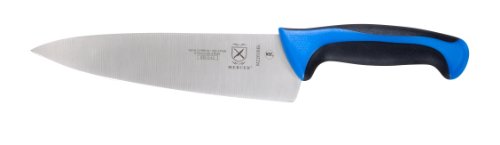
The Millennia is Mercer’s best-known working knife, and this is it with a blue handle. The listing gives model M22608BL, one-piece high-carbon Japanese steel for easy edge maintenance, and an ergonomic handle with textured finger points for a non-slip grip. It says the blue color is meant for fish and other seafood.
If your kitchen keeps a separate knife for raw shrimp and fish, for ceviche or aguachile, a blue handle makes it easy to grab the right one every time. Otherwise it is the standard Millennia 8-inch, a size most cooks can use for everything. Mercer’s listing asks for hand washing only, then drying with a soft towel.
Why we like it
- Standard 8-inch size
- Textured, non-slip handle
- Color-coded for seafood
- Sold by Amazon.com
Key specifications
| Model | M22608BL |
|---|---|
| Blade | 8 inches, high-carbon Japanese steel (listing) |
| Handle | Textured finger points, blue |
| NSF | Not stated on this listing |
| Care | Hand wash; no dishwasher |
Why we recommend it
It suits a cook who wants Mercer’s everyday chef’s knife and a color code for seafood prep.
Skip it if you want NSF confirmed by the maker; the Victorinox Fibrox line states it.
Pros and cons
Pros
- Thin factory edge, by review
- Grippy texture
- Helps keep seafood prep separate
Cons
- No NSF claim on the listing
- Hand wash only
- Same model as a knife on our other guides
4. Mercer Culinary Millennia 6-Inch Flexible Boning Knife – Bends Along Fish and Poultry Bones

Mercer’s counterpart to the Victorinox boning knife, with a flexible blade instead of a semi-stiff one. The listing gives model M23850, the same one-piece high-carbon Japanese steel and textured Millennia handle. It names its uses as deboning chicken, ham and fish and trimming fat and sinew.
A flexible blade follows the curve of a bone, which helps on fish and around chicken thighs. It is less suited to heavy pork or beef, where a stiffer blade like the Victorinox gives better control. Care is the same as every Mercer: hand wash, dry completely and never put it in the dishwasher.
Why we like it
- Flexible blade for fish and poultry
- Textured, non-slip handle
- Pairs with the Millennia chef’s knife
- Sold by Amazon.com
Key specifications
| Model | M23850 |
|---|---|
| Blade | 6 inches, flexible, high-carbon Japanese steel (listing) |
| Handle | Millennia, textured finger points |
| NSF | Not stated on this listing |
| Care | Hand wash; no dishwasher |
Why we recommend it
It suits a cook who bones chicken and fillets fish more often than they break down big cuts of pork or beef.
Skip it if you mostly work on heavy cuts; the semi-stiff Victorinox above, or the picks in our best boning knife guide, suit that better.
Pros and cons
Pros
- Bends close to the bone
- Same grip as the Millennia chef’s knife
- Affordable working knife
Cons
- Too flexible for heavy cuts
- No NSF claim on the listing
- Hand wash only
Victorinox and Mercer questions, answered
Is Victorinox better than Mercer?
Not by much. Victorinox states NSF certification for Fibrox and its knives are easier to sharpen. Mercer offers more lines, color-coded handles and forged options. Prudent Reviews recommends both, and so do we.
Which is harder steel?
They are close. Victorinox rates Fibrox at 54 to 56 HRC. Prudent Reviews puts most Mercer lines at 53 to 57 HRC, with the MX3 line at 60 to 62.
Are Mercer knives made in Japan?
Prudent Reviews says Mercer knives are made in Taiwan, though the Millennia listings describe the steel as Japanese. Victorinox knives are made in Switzerland.
Can these knives go in the dishwasher?
Mercer says no. Victorinox says its Swiss Classic line is dishwasher-safe but does not say so for Fibrox on its comparison page. Hand wash either one to keep the edge longer.
Do I need a honing steel with either brand?
Yes, it helps. Steel in the mid-50s HRC bends out of line with use, and a few strokes on a honing steel bring the edge back. See our best honing steel guide.
The knife we would hand a new cook
For most kitchens, start with a Victorinox Fibrox: maker-stated NSF certification, a grip that holds when wet and steel that is easy to keep sharp. Choose Mercer if you want a color code, a forged knife or just a different handle. Either way, you are buying the kind of knife working kitchens rely on. For more models, see our best Mercer knives guide and the best Victorinox knife set guide. And when you would rather leave the prep to us, see the menu or call to order.