Small knife work in a Mexican kitchen is fiddly and constant: scraping the veins and seeds out of a jalapeño for rajas, coring Roma tomatoes for salsa, cutting the sticky stem end off a husked tomatillo, trimming radishes into garnishes for pozole, and shaving the spines off a nopal paddle. A Japanese paring or petty knife is built for exactly that kind of control, with a thin, hard blade that holds a fine edge for a long time.
Our main best paring knife guide covers paring knives of every kind, mostly German and Swiss. This page looks only at knives made in Japan by Japanese makers, sets aside the Shun Classic, Global and Tojiro petty already covered on that page and on our best Japanese knife guide, and explains how the short paring knife and the longer petty knife differ.
Julia’s earns a commission on purchases made through links on this page, at no cost to you. Recommendations are based on what a restaurant kitchen looks for, product specifications and verified buyer reports.
Quick verdict: which Japanese paring knife to buy
The best paring knife Japanese makers sell for most home cooks is the Miyabi Kaizen II 3.5-inch: Miyabi states a 61 HRC FC61 steel core and a very fine 9.5 to 12 degree edge, on a D-shaped Pakkawood handle, made in Seki. For less, the Shun Sora 3.5-inch puts a VG10 cutting edge on an easy-care polymer handle, with Shun’s free sharpening. On a tight budget, the Kai PRO 3.5-inch gives you a hand-sharpened 16-degree edge and a riveted, full-tang handle.
Read on for the petty, peeling and ceramic options, and for the one job you should never give a hard Japanese edge.
Five Japanese paring knives compared
Our five standout picks side by side, one for each kind of cook, with the steel and edge figures each maker states. All nine knives are reviewed in full below.
| Knife | Best for | Blade | Hardness / edge (stated) | Buy on Amazon |
|---|---|---|---|---|

Miyabi Kaizen II 3.5-inch Paring KnifeBest overall
|
Fine detail work, most cooks | 3.5-inch, FC61 core, 48 layers | 61 HRC, 9.5–12° | View on Amazon |
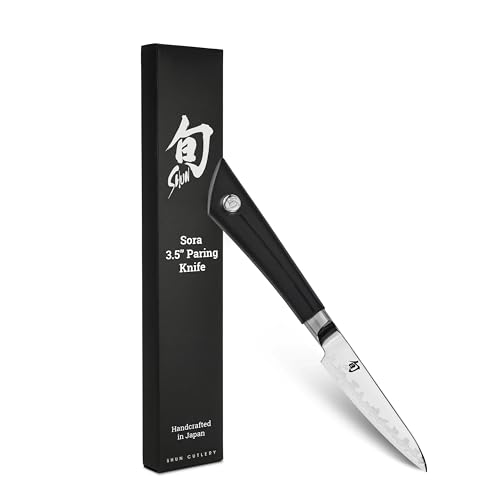
Shun Sora 3.5-inch Paring KnifeBest value
|
A Shun edge with easy care | 3.5-inch, VG10 edge, 420J upper | 16° | View on Amazon |

Kai PRO 3.5-inch Paring KnifeBudget pick
|
A budget Japanese paring knife | 3.5-inch, AUS6M, hammered | 16° | View on Amazon |

Misono UX10 13 cm Petty KnifeBest petty knife
|
Longer cuts, limes to steak | 13 cm petty, 1.8 mm spine | Not stated | View on Amazon |

Global 3-inch Peeling KnifeBest for peeling
|
Peeling and turning in the hand | 3-inch peeling, all steel | Not stated | View on Amazon |
Product images from Amazon. Hardness and edge angles appear only where the maker or its listing states them; check the listing before you buy.
Our picks for the best paring knife Japanese makers sell
All nine knives below are made in Japan by Japanese makers: Miyabi (Seki), Shun and Kai, Misono, Global, Tojiro and Kyocera. They range from a 3-inch peeling knife to a 13-centimeter petty knife, and from budget stainless to SG2 powdered steel. Each review covers what the knife is best at, what its maker states about steel, hardness and edge, and one honest reason to skip it.
1. Miyabi Kaizen II 3.5-inch Paring Knife – A Very Fine Edge From Seki
Miyabi makes its knives in Seki, Japan’s old blade-making city. Miyabi’s listing describes an FC61 steel core with fine carbide distribution, protected by 48 layers of Damascus-patterned steel, ice-hardened with Miyabi’s FRIODUR process to 61 Rockwell. The edge is hand-honed by the three-step Honbazuke method to 9.5 to 12 degrees, finer than most Western paring knives.
That fine edge is what you want for the delicate jobs: slipping under a jalapeño’s ribs to lift them out in one piece, peeling a thin ribbon of lime zest for a margarita rim, or coring a strawberry for agua fresca. The blade has what Miyabi calls an authentic, thin Japanese profile, and the D-shaped black Pakkawood handle has a thicker, rounded bolster that Miyabi says adds comfort and balance.
As with any hard, thin Japanese blade, keep it off bones and pits, do not pry with it, and wash and dry it by hand. The listing we read does not state the warranty terms.
Why we like it
- Stated 61 HRC FC61 core and 9.5 to 12 degree edge
- Hand-honed by the Honbazuke method, per Miyabi
- D-shaped Pakkawood handle with a rounded bolster
- Handcrafted in Seki, Japan
Key specifications
| Model | 34680-091 (Kaizen II) |
|---|---|
| Blade length | 3.5 inches |
| Style | Paring knife |
| Steel | FC61 core, 48-layer Damascus cladding |
| Hardness (stated) | 61 HRC |
| Edge angle (stated) | 9.5 to 12 degrees |
| Handle | Black Pakkawood, D-shaped |
| Warranty | Not stated on listing |
Why we recommend it
It suits the cook who wants a genuinely Japanese paring knife, with published figures for steel, hardness and angle, for precise work on chiles, citrus and garnishes.
Skip it if you often cut through avocado pits, mango stones or anything hard; a 9.5 to 12 degree edge on hard steel can chip.
Pros and cons
Pros
- Very fine stated edge
- Full set of published specifications
- Comfortable Japanese D-shaped handle
Cons
- Thin edge needs careful use
- Warranty not stated on the listing
- Hand wash only
2. Shun Sora 3.5-inch Paring Knife – VG10 Edge, Easy-Care Handle
Shun’s Classic paring knife is on our main paring knife page; the Sora is the less expensive way to get a Shun edge. Shun’s listing describes a San Mai edge of VG10 steel supported by a 420J stainless blade upper, a construction Shun calls its Composite Blade technology. You get hard VG10 where the cutting happens and a tougher, cheaper steel above it, sharpened to a 16-degree edge.
The handle is a textured PP/TPE polymer blend on a full tang, which Shun says gives a secure grip for left- and right-handed cooks. A textured synthetic handle is a practical choice for a paring knife, which spends a lot of time in wet hands rinsing tomatillos or working over a bowl of lime juice. Each Sora is handcrafted in Japan.
Shun backs its knives with a limited warranty against manufacturing defects and offers free sharpening for as long as you own the knife, as the listing states. Hand wash and dry it; Shun’s knives are not meant for the dishwasher.
Why we like it
- VG10 cutting edge, 16 degrees, per Shun
- Textured polymer handle on a full tang
- Free sharpening from Shun for as long as you own it
- Handcrafted in Japan
Key specifications
| Model | VB0700 |
|---|---|
| Blade length | 3.5 inches |
| Style | Paring knife |
| Steel | VG10 edge, 420J stainless upper (San Mai) |
| Hardness (stated) | Not stated on listing |
| Edge angle (stated) | 16 degrees |
| Handle | Textured PP/TPE blend, full tang |
| Warranty | Limited, defects; free sharpening |
Why we recommend it
It suits a cook who wants a Shun-made edge and a grippy, low-maintenance handle without paying for full Damascus cladding.
Skip it if you want a traditional wooden handle and a Damascus pattern; the Sora is plain and modern by design.
Pros and cons
Pros
- Shun edge at a lower price
- Grippy handle when wet
- Free sharpening service
Cons
- Hardness not stated on the listing
- Plain look compared with Shun’s Damascus lines
3. Kai PRO 3.5-inch Paring Knife – A Hand-Sharpened Edge on a Budget
Kai is the company behind Shun (Shun’s own listing names Kai USA as its seller), and Kai PRO is its line built, Kai says, for rigorous use. Kai’s listing describes a blade of Japanese AUS6M stainless steel with a hand-sharpened 16-degree edge and a hammered tsuchime finish that helps release food, useful when you slice small, wet things like cherry tomatoes or radishes.
The handle is POM, a tough engineering plastic, securely riveted to a full-tang blade. Kai says it gives a sturdy, comfortable grip, and it is the most Western-feeling handle among the Japanese-made knives here, which makes it an easy step for someone coming from a German paring knife.
AUS6M is a softer steel than VG10 or SG2, so it will want honing more often, but it is also more forgiving if the edge meets a cutting board too hard or a stray seed. Kai offers free sharpening and honing, according to the listing.
Why we like it
- Hand-sharpened 16-degree edge, per Kai
- Hammered finish to help release food
- Full tang with a riveted POM handle
- Free sharpening and honing from Kai
Key specifications
| Model | HT7068 |
|---|---|
| Blade length | 3.5 inches |
| Style | Paring knife |
| Steel | AUS6M stainless |
| Hardness (stated) | Not stated on listing |
| Edge angle (stated) | 16 degrees |
| Handle | POM, riveted, full tang |
| Warranty | Manufacturer warranty (terms not stated) |
Why we recommend it
It suits a cook who wants a Japanese-made paring knife at a modest price, with a familiar riveted handle and a softer steel that is easy to keep sharp.
Skip it if you want the long edge retention of a harder steel; AUS6M will need honing more often than the Miyabi or Shun.
Pros and cons
Pros
- Low cost for a Japanese-made knife
- Tough handle and full tang
- More forgiving steel
Cons
- Softer steel loses its edge sooner
- Warranty terms not stated on the listing
4. Misono UX10 13 cm Petty Knife – Extra Reach for Limes and Steak
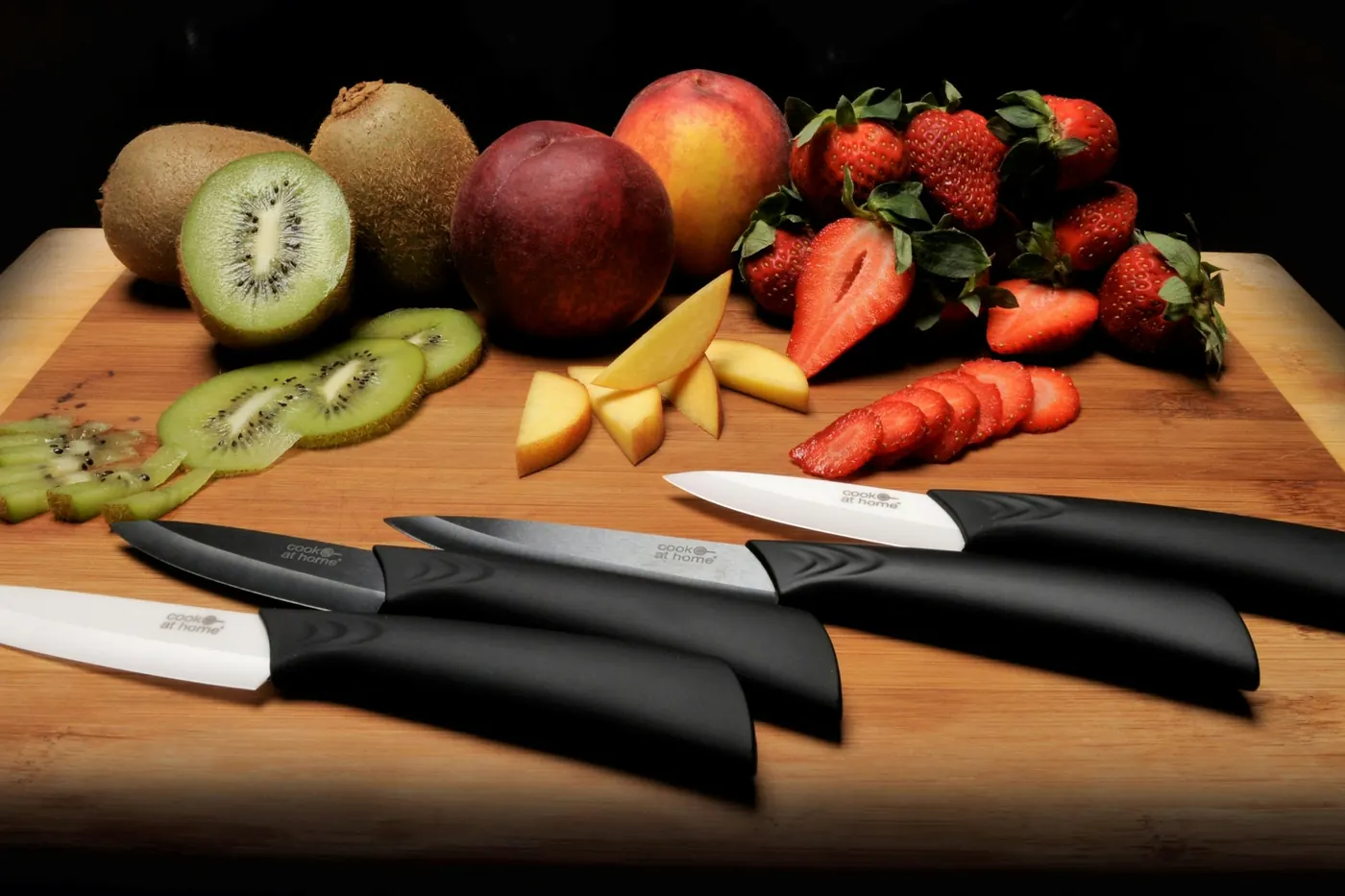
A petty knife is the Japanese in-between: longer than a paring knife, shorter than a utility or chef’s knife. At 13 centimeters (5.1 inches), Misono’s UX10 petty reaches across a big orange or a whole tomato, trims a skirt steak, or halves a stack of limes on the board, and it is still small enough to pare in the hand. Misono’s listing gives a total length of 24 cm, a spine just 1.8 mm thick and a weight of 80 grams.
The UX10 is Misono’s top stainless line, described on the listing as high-purity stainless steel, with a black reinforced wood handle. A thin spine like this slices cleanly through tomatoes and onions without wedging, which is exactly the job a paring knife struggles with once the vegetable gets bigger than a fist.
The listing does not state hardness, edge angle or warranty terms, so we have not listed them. Its sibling, the Misono UX10 gyuto, is reviewed on our main Japanese knife page; the petty is a different knife for a different job.
Why we like it
- 13 cm blade for board work and in-hand paring
- Thin 1.8 mm spine, per Misono
- Light at 80 grams
- Made in Japan
Key specifications
| Model | No. 732 |
|---|---|
| Blade length | 5.1 inches (13 cm) |
| Style | Petty knife |
| Steel | High-purity stainless (UX10) |
| Hardness (stated) | Not stated |
| Edge angle (stated) | Not stated |
| Handle | Black reinforced wood |
| Warranty | Not stated on listing |
Why we recommend it
It suits the cook who finds a 3.5-inch paring knife too short for tomatoes, citrus and small cuts of meat, and wants one small knife that works both on the board and in the hand.
Skip it if you mostly peel and trim in the hand; a 13 cm blade is less nimble for turning small fruit than a 3-inch knife.
Pros and cons
Pros
- Versatile length
- Thin, light blade
- Misono’s premium stainless line
Cons
- Few specifications stated
- Wood handle needs drying after washing
5. Global 3-inch Peeling Knife – All-Steel and Made for Turning Fruit
Global’s classic paring knife is on our main paring page; this is a smaller, different tool. The GSF-15 is a 3-inch peeling knife that Global describes as precisely balanced for cleaning and peeling vegetables and fruit. A short blade gives the most control when you hold the fruit in one hand and pull the knife toward your thumb, the way you peel a mango, a jícama or a plantain.
Like every Global, it is all stainless: a blade of molybdenum/vanadium stainless steel that Global says retains its edge well, and a stainless steel handle molded for comfort and dimpled for grip. There is no wood or rivet to loosen and no seam where food can collect.
Global covers it with a lifetime warranty against defects and breakage. A small steel handle can feel slick with wet hands, so keep a towel close when you are peeling juicy fruit.
Why we like it
- Short 3-inch blade for in-hand peeling
- Molybdenum/vanadium stainless steel
- Seamless stainless handle with dimpled grip
- Lifetime warranty against defects and breakage
Key specifications
| Model | GSF-15 |
|---|---|
| Blade length | 3 inches (8 cm) |
| Style | Peeling knife |
| Steel | Molybdenum/vanadium stainless |
| Hardness (stated) | Not stated |
| Edge angle (stated) | Not stated |
| Handle | Stainless steel, dimpled |
| Warranty | Lifetime, defects and breakage |
Why we recommend it
It suits the cook who does most small-knife work in the hand rather than on the board: peeling fruit, trimming chiles and turning vegetables.
Skip it if you want one small knife for board work as well; a 3-inch blade runs out of length on a tomato.
Pros and cons
Pros
- Excellent control in the hand
- Hygienic one-material design
- Breakage covered by warranty
Cons
- Short for board work
- Steel handle can be slippery when wet
6. Shun Premier 4-inch Paring Knife – Hammered Finish, Longer Blade

The Premier is Shun’s more decorative line, and its paring knife is half an inch longer than the Shun Classic on our main paring knife page. Shun’s listing describes a VG-MAX steel core clad in 68 layers of Damascus stainless, sharpened to 16 degrees, with a hammered tsuchime finish that Shun says reduces drag and stops food sticking.
That extra half inch is handy for coring tomatoes and cutting citrus wedges, and the hammered surface helps thin slices of radish or jalapeño fall away from the blade rather than clinging to it. The contoured brown Pakkawood handle is shaped for left- and right-handed use, and each knife is handcrafted in Japan.
Shun backs the Premier with a limited lifetime warranty and free sharpening and honing, according to the listing. Hand wash and dry it, and keep it off bones, pits and frozen food.
Why we like it
- VG-MAX core with 68-layer Damascus cladding
- Hammered finish to help release food, per Shun
- 4-inch blade, a little longer than most paring knives
- Limited lifetime warranty and free sharpening
Key specifications
| Model | TDM0700 |
|---|---|
| Blade length | 4 inches |
| Style | Paring knife |
| Steel | VG-MAX core, 68-layer Damascus |
| Hardness (stated) | Not stated on listing |
| Edge angle (stated) | 16 degrees |
| Handle | Contoured Pakkawood |
| Warranty | Limited lifetime; free sharpening |
Why we recommend it
It suits the cook who wants a handsome, slightly longer Shun paring knife to match a Premier chef’s knife, or a gift for someone who loves Japanese knives.
Skip it if you want the best value; the Sora gives you a Shun edge for considerably less.
Pros and cons
Pros
- Attractive hammered Damascus blade
- Food releases more easily
- Shun’s warranty and sharpening service
Cons
- Among the more expensive knives here
- Hardness not stated on the listing
7. Miyabi Mizu SG2 3.5-inch Paring Knife – The Hardest Stated Steel Here

If edge retention is what you care about most, the Mizu has the highest hardness figure on this page. Miyabi’s listing describes SG2 micro-carbide powdered stainless steel, ice-hardened by its CRYODUR process to 63 Rockwell, with a hammered Damascus finish and a 12-degree double-bevel edge from the three-step Honbazuke method.
A 63 HRC blade stays sharp through a long session of seeding chiles and coring tomatoes, but it is also the most brittle steel here. Treat it like a scalpel: push and slice, never twist or pry, and keep it well away from pits, bones and glass or stone boards.
The handle is Micarta, a durable resin composite, in a D shape with a bolster and a metal end cap. The knife is made in Seki, Japan, and carries a limited lifetime warranty, per the listing.
Why we like it
- SG2 powdered steel at a stated 63 HRC
- 12-degree double-bevel Honbazuke edge
- Durable Micarta D-shaped handle
- Limited lifetime warranty
Key specifications
| Model | 32910-093 |
|---|---|
| Blade length | 3.5 inches |
| Style | Paring knife |
| Steel | SG2 micro-carbide powder stainless |
| Hardness (stated) | 63 HRC |
| Edge angle (stated) | 12 degrees, double bevel |
| Handle | Micarta, D-shaped |
| Warranty | Limited lifetime |
Why we recommend it
It suits an experienced cook who sharpens on stones and wants the longest-lasting edge available in a small Japanese knife.
Skip it if you are rough with small knives or use them to pry; very hard steel chips rather than bends.
Pros and cons
Pros
- Highest stated hardness here
- Very fine edge
- Tough Micarta handle
Cons
- Most brittle steel on the page
- Needs whetstone sharpening
8. Tojiro DP Damascus 4.5-inch Utility Knife – VG10 Core With a Bolster

Tojiro’s plain DP petty is reviewed on our main Japanese knife page. This is a different knife from the same maker: a 4.5-inch utility knife with a Damascus pattern made, Tojiro says, by forging 37 layers of low- and high-carbon stainless steel over a thick VG10 cobalt-alloy core.
Unlike most Japanese small knives, it has a bolster, which Tojiro says adds heft and balance while the blade and edge stay thin. The handle is Micarta with three stainless steel rivets. Tojiro lists it for paring, peeling and slicing small fruit and vegetables, and at 4.5 inches it sits between a paring knife and a petty, useful for halving limes and slicing radishes on the board.
The listing does not state hardness, edge angle or warranty terms. Wash and dry it by hand.
Why we like it
- VG10 cobalt-alloy core, per Tojiro
- Bolster for heft and balance
- Micarta handle with three rivets
- Made in Japan
Key specifications
| Model | F-650 |
|---|---|
| Blade length | 4.5 inches |
| Style | Utility / petty |
| Steel | VG10 core, 37-layer Damascus cladding |
| Hardness (stated) | Not stated |
| Edge angle (stated) | Not stated |
| Handle | Micarta, three rivets |
| Warranty | Not stated on listing |
Why we recommend it
It suits a cook who likes the feel of a Western knife with a bolster but wants a VG10 Japanese edge in a small, versatile size.
Skip it if you want the lightest possible knife; the bolster adds weight that some cooks dislike for in-hand peeling.
Pros and cons
Pros
- Hard VG10 core
- Familiar Western-style handle
- Versatile 4.5-inch length
Cons
- Few specifications stated
- Heavier than a plain petty
9. Kyocera Revolution 3-inch Ceramic Paring Knife – A Rust-Proof Zirconia Blade

Kyocera makes its ceramic blades from its own zirconia, produced in Japan. A ceramic blade is a very different tool from steel: Kyocera says it is about half the weight of a steel knife, does not rust, and is non-reactive, so it will not leave a metallic taste on cut fruit or turn it brown at the cut, which is pleasant for slicing apples, pears or jícama sticks for a fruit cup with chile and lime.
The trade-off is toughness. Kyocera itself says the knife is meant for small fruit and vegetables and not for hard or frozen foods, and its five-year limited warranty against breakage excludes cutting bones, prying and flexing. Use it for slicing and peeling soft produce, and keep a steel knife for anything with a pit.
Ceramic edges stay sharp for a long time but cannot be honed on a steel rod; when the edge eventually dulls, it needs a diamond sharpener made for ceramic blades.
Why we like it
- Zirconia blade made in Japan, per Kyocera
- Light, about half the weight of steel, per Kyocera
- Will not rust and does not react with acidic fruit
- Five-year limited warranty against breakage
Key specifications
| Model | FK-075 WH-RD |
|---|---|
| Blade length | 3 inches |
| Style | Paring knife (ceramic) |
| Steel | Zirconia ceramic (not steel) |
| Hardness (stated) | Not stated |
| Edge angle (stated) | Not stated |
| Handle | Lightweight plastic, red |
| Warranty | 5-year limited, breakage (excludes bones, prying, flexing) |
Why we recommend it
It suits a cook who slices a lot of fruit and soft vegetables and wants a light, rust-proof knife that keeps its edge with no honing at all.
Skip it if you cut anything hard or pry with a small knife; ceramic blades chip or snap under twisting force.
Pros and cons
Pros
- Very light
- Rust-proof and non-reactive
- Long-lasting edge
Cons
- Brittle with hard foods and twisting
- Needs special sharpening
- Not a steel Japanese knife, if that is what you want
Paring, petty or peeling: which small Japanese knife
Japanese makers sell three kinds of small knife, and they suit different hands and jobs.
Paring knives (about 3.5 to 4 inches) are the all-rounders: short enough to peel and trim in the hand, long enough to core a tomato or seed a jalapeño on the board. The Miyabi, Shun and Kai knives above are paring knives.
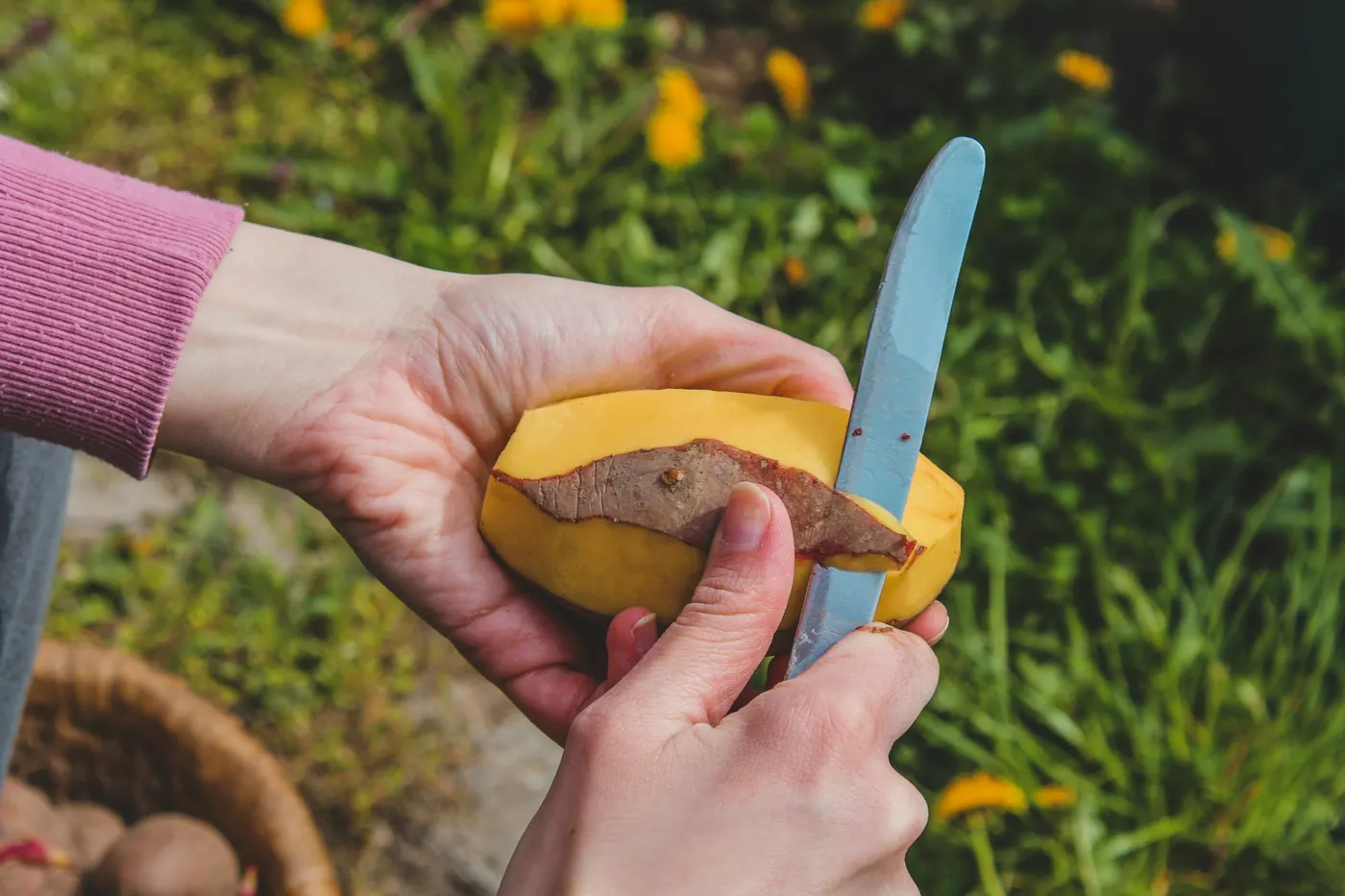
Peeling knives (around 3 inches or less) give the most control in the hand, for turning a mango or peeling a plantain. Global’s GSF-15 is one.
Petty knives (about 12 to 15 centimeters) are small utility knives. They are better than a paring knife on the board, for slicing tomatoes, limes and small cuts of meat, and still manageable in the hand. Misono’s UX10 and Tojiro’s 4.5-inch knife fill this role.
How to choose a Japanese paring knife
1. Steel and hardness
Harder steel holds an edge longer but chips more easily. Makers here state 61 HRC for the Miyabi Kaizen II and 63 HRC for the Mizu; AUS6M on the Kai PRO is softer and more forgiving. If a maker does not state hardness, we say so rather than guess.
2. Edge angle
Japanese small knives are sharpened finer than Western ones: Shun and Kai state 16 degrees, Miyabi 9.5 to 12. A finer edge cuts more cleanly through tomato skin and chile flesh, but it wears faster and needs a gentler hand. Our guide to the best whetstone covers how to keep that angle.
3. Length
Choose 3 to 3.5 inches if you mostly work in the hand, 4 to 4.5 inches if you split time between hand and board, and a 13 to 15 cm petty if you mostly cut on the board.
4. Handle
Japanese D-shaped handles (Miyabi) sit well in a pinch grip; textured synthetic handles (Shun Sora) stay grippy when wet; steel handles (Global) are seamless but slicker. Wood and Pakkawood handles need drying after washing.
5. What you will cut
Every steel knife here is happiest on soft produce and cooked meat. None is meant for prying out avocado pits, cutting through chicken bones or opening packages. Keep a cheap, tough knife for those jobs.
How we chose these nine knives
We started from the small-knife jobs in a Mexican kitchen: seeding and deveining chiles, coring tomatoes, trimming tomatillos, peeling fruit, cleaning nopales and cutting garnishes. We then looked only at paring, peeling and petty knives made in Japan by Japanese makers and sold on Amazon in the United States, and kept only those that were in stock when we checked. To keep this page distinct from our main paring knife, Japanese knife and Japanese knife set guides, we left out the knives they already review (the Shun Classic and Global Classic paring knives and the plain Tojiro DP petty) and chose other models from those makers where we included them. Specifications come from each maker’s Amazon listing, and each review says what is stated and what is not. We left out marketplace brands selling “Japanese” knives without a named Japanese maker, and several good knives (Mac’s paring knives, Masamoto and most Misono petty knives) that were scarce or out of stock. We have not used these knives ourselves, and no performance claim here goes beyond what the maker states.
Japanese paring knife questions, answered
What is the best Japanese paring knife?
For most cooks, the Miyabi Kaizen II 3.5-inch, for its stated 61 HRC core and fine Honbazuke edge. The Shun Sora is the best value, and the Kai PRO is the budget pick.
Is a petty knife the same as a paring knife?
No. A petty knife is longer, usually 12 to 15 centimeters, and works more like a small utility knife on the board. A paring knife is shorter and better for work in the hand. Many Japanese-knife owners keep both.
Are Japanese paring knives worth it?
If you do a lot of fine work, such as seeding chiles, coring tomatoes and peeling fruit, a harder, thinner Japanese edge stays sharp longer and cuts more cleanly. If your paring knife mostly opens packages and pries pits, a cheaper, softer Western knife is the better tool.
Can I put a Japanese paring knife in the dishwasher?
None of the makers here recommends it. Wash by hand straight after cutting acidic foods such as lime and tomato, and dry the knife before you put it away.
Is a ceramic paring knife Japanese?
Kyocera’s are: the company states that its zirconia blades are produced in Japan. Ceramic is lighter and rust-proof but more brittle than steel, so it suits slicing soft fruit rather than general paring.
Our pick for small, precise work
Choose the Miyabi Kaizen II for the finest stated edge and full specifications, the Shun Sora for a Shun edge with easy-care handling, or the Kai PRO if you want a Japanese-made paring knife at a modest price. Add the Misono UX10 petty if you want one small knife that also slices on the board.
For the rest of the kit, our guides to the best Japanese knife and the best Japanese knife set cover the larger blades. For what you will be seeding and coring, see Mexican chiles explained and salsa roja vs salsa verde. And if you would rather leave the prep to someone else tonight, see the menu or call to order.