A nakiri and a santoku sit next to each other in most Japanese knife ranges, and at a glance they look like cousins: both are short, tall and thin, and both come from Japanese home kitchens. The difference is in the outline. A nakiri is a rectangle with a straight edge and a square tip. A santoku has a gently curved edge that drops to a point. That one change decides how each knife moves on the board, what it is good at and which one belongs in your drawer first.
In a restaurant kitchen the vegetable prep never stops: onions, cabbage for tacos, cilantro, radishes, chiles. This guide compares the two shapes on cutting motion, tip work, the jobs each can and can’t do, sharpening and care, then says who should buy which and names one matched pair from the same German maker, so the only real difference between the two picks is the blade shape.
Julia’s earns a commission on purchases made through links on this page, at no cost to you. Recommendations are based on what a restaurant kitchen looks for, product specifications and verified buyer reports.
Quick verdict: nakiri or santoku first?
Buy a santoku first if you want one Japanese-style knife for everything: vegetables, boneless meat, fish and fine tip work. It is the more versatile shape, and for most home cooks it is the better first buy. Buy a nakiri if you already own a chef’s knife or santoku and you chop a lot of vegetables, especially by chopping straight down or pushing the blade forward through onions, cabbage and herbs. A nakiri is a specialist, and a very good one, but it is not the knife to own on its own.
The table sums up the differences; the sections after it explain each one.
Nakiri vs santoku, side by side
| Nakiri | Santoku | |
|---|---|---|
| Outline | Rectangular, straight edge, blunt square tip (America’s Test Kitchen) | Gently curved edge, spine drops to a point, often called a sheep’s foot tip (America’s Test Kitchen) |
| Main motion | Straight up-and-down chop and push cut; no rocking | Straight chop plus a slight rock on most modern models |
| Best at | Vegetables, herbs and fruit | Vegetables, boneless meat and fish |
| Tip work | None; the tip is square | Some; a point for scoring and small cuts |
| Typical length | About 6.5 to 7 inches | 5 to 7 inches (America’s Test Kitchen) |
| Bevel | Double bevel (Knifewear) | Double bevel |
| Avoid | Bone, frozen food, dense squash (America’s Test Kitchen) | Bone and frozen food, as with any thin knife |
| Who it suits | A second knife for vegetable-heavy cooks | A first or only Japanese-style knife |
Blade shape: a rectangle against a curve
America’s Test Kitchen describes the nakiri as having “a rectangular blade with a relatively straight edge and a blunted tip.” Zwilling calls it a “broad, rectangular blade.” Knifewear, the Canadian Japanese-knife retailer, adds that the edge is “very flat,” so the whole blade meets the board at once “without the need for follow-through.” That flatness is the whole point of the knife. When you chop a scallion or a stack of cabbage leaves, every part of the edge touches the board together, so nothing is left joined by a thread.
The santoku keeps the tall blade but changes the outline. America’s Test Kitchen says early santokus were flatter, following the vegetable cleaver they descended from, but most newer models have “gently curved bottom edges that allow for a subtle rocking motion.” The spine curves down to meet the edge in what ATK calls a turned-down sheep’s foot tip. Zwilling describes the same feature as a blade back that flattens towards the tip. Victorinox, meanwhile, describes the santoku’s edge as flat and wide. Both descriptions are fair: the santoku’s edge is far flatter than a Western chef’s knife, but rarely as dead straight as a nakiri’s.
Both are usually double beveled, ground and sharpened on both sides. Knifewear notes that this makes a nakiri “easier to use and easier to sharpen” than a single-bevel usuba, and suits left- and right-handed cooks alike. Our best nakiri knife guide explains the usuba in more detail.
Cutting motion: push and chop, or chop and a little rock
This is where the two knives feel most different in the hand. ATK is plain about the nakiri: “you can’t rock through a cut from tip to heel, the way you might with a Western-style chef’s knife.” Instead you “chop in an up-and-down motion.” Zwilling says the nakiri is made for “pushing cutting techniques”: you set the edge on the food and drive it forward and down in one stroke. Shredding cabbage for slaw, slicing a pile of onions for pickling or cutting cucumbers into thin coins all suit that motion very well, and the tall, straight blade guides each slice.
The santoku does those cuts too. Victorinox describes its typical use as “straight chopping motions,” and that is how most people use one. But the curve gives you a bit more freedom. ATK found that most of the santokus it reviewed allow a subtle rock, which helps when you mince herbs or garlic. If you were raised on a chef’s knife and like to rock, the santoku will feel more familiar, and a nakiri may feel stiff for the first few weeks.
Neither knife rocks like a chef’s knife. If rocking is how you cut, our santoku vs chef knife comparison is the more useful read.
Tip work: the santoku’s clear advantage
A nakiri has no point. That makes it a poor choice for jobs that need one: scoring the skin of a pork shoulder, cutting the core out of a tomato, splitting a chile lengthwise and scraping out the seeds, or trimming the silverskin from a flank steak. You can do some of these with the heel, but it is awkward.
The santoku’s point is not as sharp or as fine as a chef’s knife’s. ATK found that the turned-down tip puts extra metal behind the point, which made delicate tip work harder, and called the design “more of a problem than a perk” in that respect. Even so, a santoku has a usable point and a nakiri doesn’t. That alone is why the santoku works as an only knife and the nakiri does not.
What each knife should and shouldn’t cut
Wüsthof says its nakiri is designed “to prep vegetables, herbs and fruit very quickly and finely” and “is not suitable for rough tasks (such as splitting bones).” ATK goes further: the nakiri’s blade “is very thin, hard, and brittle,” so keep it away from bone-in meat, frozen food and dense squash or pumpkin, where it can chip. Knifewear’s writer uses one to mince “a big mountain of garlic and cilantro,” which is a good picture of where it shines.
The santoku has a wider job description. Zwilling says it is suited to “fish, meat and vegetables,” and Victorinox lists slicing and dicing, fish and boneless meat. Wüsthof says the blade allows “anything from regular to wafer-thin cuts” and works for fish and meat as well as produce. ATK concluded that a good santoku can “mince, slice, and chop as well as any good chef’s knife.” It is still a thin Japanese-style blade, so treat it with the same care: no bones, no frozen blocks, no prying.
For bone and the heavy jobs, neither is the right tool. Our best cleaver guide covers knives built for that.
Size, height and knuckle room
Both knives are short by Western standards. ATK puts santokus at 5 to 7 inches, against 8 to 10 inches for most chef’s knives, and nakiris commonly run from about 6.5 to 7 inches. Short is easier to control on a small cutting board, and it suits cooks with smaller hands.
Both are also tall. Knifewear points out that the nakiri’s height keeps your knuckles off the board as you chop, and its tall, flat side doubles as a scoop: Zwilling notes that food “can be picked up directly with the blade.” A santoku is tall at the heel too, though the dropped tip means less height towards the front. In the matched Wüsthof pair below, the maker lists the nakiri’s blade at 1.9 inches wide and the santoku’s at 1.8 inches, so the difference near the handle is small; it is the front half of the blade that changes.
Hollow edges: nice to have, not a reason to choose
Many nakiris and santokus, including both picks on this page, have a row of oval dimples just above the edge. Wüsthof says they let small pockets of air form so ingredients stick less. ATK reviewed seven santokus with this kind of edge, saw no difference in sticking and called the feature “unnecessary.” Don’t let dimples decide between the two shapes; the outline matters far more.
Sharpening and care
Here the two are equal. Both are thin, both are usually double beveled, and Japanese-style blades are often sharpened to a narrower angle than Western knives. Wüsthof, for example, sharpens its standard blades to 14 degrees per side and its Asian-style blades, santokus and nakiris both, to 10 degrees per side. Keep that angle when you sharpen, either on a whetstone or a sharpener with an Asian setting; our best whetstone guide covers the stones.
The nakiri’s straight edge is easy to follow on a stone because there is no curve to manage. The santoku’s curve takes slightly more care near the tip. On either, wash by hand and dry straight away, as Wüsthof asks for both of its models, and use a wooden or plastic board. Our best cutting board guide covers boards that are kind to a thin edge.
Choose a nakiri if… / Choose a santoku if…
Choose a nakiri if…
- You already own a chef’s knife or santoku and want a second knife for vegetables.
- You chop straight down or push forward, rather than rocking.
- Your prep is heavy on onions, cabbage, herbs, radishes and cucumbers.
- You want the simplest edge to follow on a whetstone.
Choose a santoku if…
- You want one short Japanese-style knife for nearly everything.
- You cut boneless meat and fish as well as vegetables.
- You need a point for coring, scoring and small trimming jobs.
- You like a little rocking motion when you mince.
Our pick on each side of the nakiri vs santoku question
One pick per side, both from Wüsthof’s forged Classic line, which keeps the comparison fair: the same steel, hardness, edge angle, handle and length, so the only real difference is the blade shape. Both were in stock when we checked. The nakiri listing appears on none of our other pages. The santoku is the same knife as the Wüsthof Classic 7-inch Hollow Edge Santoku in our best santoku knife guide, sold through a different Amazon listing; we include it on purpose so the pair matches. If you want Japanese-made knives instead, see the notes at the end of this page.
1. Wüsthof Classic 7-inch Hollow Edge Nakiri – A Forged Vegetable Specialist

This is the nakiri shape built the German way: a forged, full-tang blade with a bolster and a triple-riveted synthetic handle. Wüsthof calls it “the Japanese vegetable knife” and says it is “extremely versatile and suitable for tasks such as cutting, dicing or chopping.” The blade is 7 inches long and 1.9 inches wide, according to the maker, with a row of hollows above the edge to reduce sticking.
Wüsthof sharpens it to 10 degrees per side, narrower than its Western knives, and lists the steel at 58 HRC. That is softer than many Japanese-made nakiris, which means the edge may need sharpening a little more often but is less likely to chip, a fair trade for a busy home kitchen. The listing describes the shape as “cleaver-inspired” for control during produce prep.
Wüsthof is clear about its limits: it “is not suitable for rough tasks (such as splitting bones).” Wash it by hand and dry it right away. It is made in Solingen, Germany, with a limited lifetime warranty against manufacturing defects.
Why we like it
- Flat 7-inch edge for straight chopping and push cuts
- Forged, full tang, with a bolster (Wüsthof)
- 10-degree-per-side edge (Wüsthof)
- Limited lifetime warranty
Key specifications
| Model | 1040132617 |
|---|---|
| Blade length | 7 inches |
| Blade width | 1.9 inches |
| Edge angle | 10 degrees per side |
| Hardness | 58 HRC |
| Construction | Forged, hollow edge |
| Made in | Solingen, Germany |
| Care | Hand wash, dry at once |
Why we recommend it
It suits a cook who already has a main knife and wants a sturdy, forgiving nakiri for daily vegetable prep, from a maker with a long warranty.
Skip it if you want a thinner, harder Japanese-made blade; our best nakiri knife guide starts with Shun and Mac.
Pros and cons
Pros
- Straight edge meets the board all at once
- Forged blade with a bolster for control
- Clear maker care and warranty terms
Cons
- No point for tip work
- Not for bones or frozen food
- Softer steel than many Japanese-made nakiris
2. Wüsthof Classic 7-inch Hollow Edge Santoku – One Knife for Most Prep
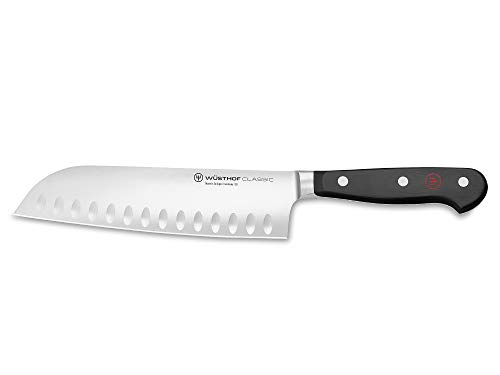
This is the same knife in the santoku shape: the same forged Classic construction, the same handle and the same 7-inch length, with a curved edge and a dropped point. Wüsthof says it is “so versatile in shape, weight and edge that it can be used for mincing and chopping herbs, vegetables and fruit,” and that the blade “allows anything from regular to wafer-thin cuts” of fish and meat as well.
The maker lists the blade at 1.8 inches wide, sharpened to 10 degrees per side, at 58 HRC, with oval hollows above the edge to reduce sticking. The listing calls it a forged, full-tang knife with a full bolster. Wüsthof’s product page describes it as having a hollow edge; the Amazon listing title doesn’t say so, but the model number matches.
Care is the same as the nakiri: wash it by hand, dry it at once, no dishwasher and no soaking in the sink, according to Wüsthof. It is made in Solingen, Germany, with a limited lifetime warranty.
Why we like it
- Curved edge allows a slight rock for mincing
- A usable point for coring and trimming
- Same forged build and warranty as the nakiri
- Maker names fish and meat as well as produce
Key specifications
| Model | 1040131317 |
|---|---|
| Blade length | 7 inches |
| Blade width | 1.8 inches |
| Edge angle | 10 degrees per side |
| Hardness | 58 HRC |
| Construction | Forged, hollow edge |
| Made in | Solingen, Germany |
| Care | Hand wash, dry at once |
Why we recommend it
It suits a cook who wants one short, sturdy knife for vegetables, chicken breasts, fish fillets and herbs, and who prefers a forged German blade to a thin Japanese one.
Skip it if you mainly rock your knife; a chef’s knife suits that better, as our santoku vs chef knife comparison explains.
Pros and cons
Pros
- Handles meat, fish and vegetables
- Point for small jobs
- Clear maker care and warranty terms
Cons
- Turned-down tip is less fine than a chef’s knife point
- Amazon listing title omits the hollow edge
- Same model as a pick in our best santoku knife guide
Nakiri and santoku questions, answered
Is a nakiri better than a santoku for vegetables?
For straight chopping and push cuts through a lot of vegetables, often yes: the flat edge meets the board along its whole length, so slices separate cleanly. For a mix of vegetables, meat and small tip jobs, the santoku is more useful.
Which Japanese vegetable knife should a beginner buy?
A santoku. It does nearly everything a nakiri does with vegetables and adds a point and the ability to cut boneless meat and fish. Add a nakiri later if you find you mostly chop vegetables.
Can a nakiri cut meat?
It can slice boneless meat, but that is not what it is for. Wüsthof designs its nakiri for vegetables, herbs and fruit, and ATK warns against bone-in proteins and frozen food because the thin blade can chip.
Do I need both a nakiri and a santoku?
Most home cooks don’t. A santoku or a chef’s knife covers daily cooking. A nakiri earns its place only if vegetable prep is a large part of what you do.
Can you rock a nakiri like a chef’s knife?
No. ATK says you can’t rock through a cut from tip to heel; chop up and down or push forward instead. A santoku allows a slight rock on most modern models.
Which one to reach for first
For most kitchens the santoku comes first, because it does almost everything and the nakiri does mostly one thing. If you already have a good main knife and you spend your prep time on onions, cabbage and herbs, a nakiri is a genuine upgrade for that work, not a gimmick. For Japanese-made options on either side, see our best nakiri knife guide, which covers Shun, Mac, Global, Tojiro and Miyabi, and our best santoku knife guide, which covers Mac, Victorinox, Shun and Zwilling. On a tighter budget, our best cheap nakiri knife guide starts with Zwilling and Mercer.
And when you would rather someone else did the chopping, see the menu or call to order.