A santoku is the knife many home cooks reach for first: a short, tall blade with a flat edge that chops onions, slices tomatoes and minces cilantro without the rocking motion a long chef’s knife asks for. It is also a knife you do not need to spend much on. The steel in an entry-level santoku from a maker you know is good enough for a home kitchen; what changes as you go down the range is how the blade is made, what the handle is made of and how much care the knife needs.
This guide covers only the entry tier of each maker’s range. Our main guide to the best santoku knife covers the step-up knives from Mac, Shun and Wüsthof’s Classic line, and the best Japanese santoku knife guide covers made-in-Japan blades. None of the eight knives below appear on either page. Prices change too often to quote, so instead we explain how to judge value: what the cheaper construction gives up, and what it does not.
Julia’s earns a commission on purchases made through links on this page, at no cost to you. Recommendations are based on what a restaurant kitchen looks for in a prep knife, the makers’ own specifications, the details on each Amazon listing and published equipment reviews, which we cite.
Quick verdict: which cheap santoku knife to buy
For most kitchens, the best cheap santoku knife is the Victorinox Swiss Classic 7-inch Granton Santoku: Swiss made, a fluted edge that helps food fall away, and Victorinox says it is dishwasher safe. If you want a Japanese-style knife with a free sharpening service, buy the Kai Wasabi 6.5-inch Santoku. If you prefer the weight of a forged German blade, the Mercer Genesis 7-inch Santoku is the least expensive way into one from a restaurant-supply maker.
Below are the five standouts side by side, all eight knives in detail, and a plain guide to telling a good-value santoku from one that only looks cheap.
Five budget santoku knives at a glance
Our five standout knives, one for each kind of cook, with the blade, edge and care each maker or listing states. All eight are reviewed in full below.
| Knife | Best for | Blade & edge | Care (per maker) | Buy on Amazon |
|---|---|---|---|---|

Victorinox Swiss Classic 7-inch Granton SantokuBest overall
|
Everyday chopping, easy care | 7 in, fluted (granton) | Dishwasher safe | View on Amazon |

Kai Wasabi 6.5-inch SantokuBest Japanese-style
|
A light knife with free sharpening | 6.5 in, plain | Not stated | View on Amazon |

Mercer Genesis 7-inch SantokuBest forged budget
|
Cooks who like a heavier knife | 7 in, plain, forged | Hand wash only | View on Amazon |

Henckels Solution 7-inch SantokuBest for the dishwasher
|
Busy households, low upkeep | 7 in, stamped | Dishwasher or by hand | View on Amazon |

Wüsthof Gourmet 5-inch Hollow Edge SantokuBest small santoku
|
Small hands, small jobs | 5 in, hollow edge, 10° | Hand wash only | View on Amazon |
Product images from Amazon. Blade length, edge and care instructions are as stated by each maker or listing; check the listing before you buy.
Our picks for the best cheap santoku knife
These eight knives come from established cutlery and cookware makers, and each is the entry point of its maker’s range rather than a discounted premium knife. Between them they cover the choices that matter at this level: stamped or forged, plain or fluted edge, dishwasher or hand wash, and a 5-inch or 7-inch blade. Each pick explains who it suits, the specifications that matter and one honest reason to skip it.
1. Victorinox Swiss Classic 7-inch Granton Santoku – Swiss Made and Dishwasher Safe
Victorinox’s Swiss Classic line is the home-kitchen sibling of the Fibrox knives you see in restaurant kitchens, and this 7-inch santoku is its everyday all-rounder. The listing describes a sharp stainless steel blade with a fluted edge: the shallow scallops along the side of the blade that reduce sticking and friction when you slice potatoes, cucumbers or cheese. Victorinox calls the knife lightweight and well balanced, and says it is Swiss made.
The detail that makes it our first pick for a budget is care. Victorinox states that this knife is dishwasher safe, which most makers on this page do not. Hand washing still keeps any edge sharper for longer, but a knife that survives the occasional run through the dishwasher is the realistic choice for a busy family kitchen.
A note for readers coming from our main best santoku knife guide: that page recommends the Victorinox Fibrox 7-inch santoku, which has a textured, grippy handle aimed at professional kitchens. The Swiss Classic is a different knife in the same family, with a smoother black handle designed for home cooks.
Why we like it
- Dishwasher safe, according to Victorinox.
- Fluted edge to reduce sticking, per the listing.
- Swiss made, as Victorinox states.
- A light, balanced all-rounder, in the maker’s description.
Key specifications
| Model | 6.8523.17B |
|---|---|
| Blade length | 7 in (listed as 6.7 in) |
| Edge | Fluted (granton) |
| Steel | Stainless steel |
| Construction | Not stated |
| Handle | Black ergonomic handle (material not stated) |
| Care | Dishwasher safe |
| Made in | Switzerland |
Why we recommend it
This is the santoku we would hand to anyone setting up a first kitchen or replacing a dull knife from a block set: light, easy to care for and from a maker with a long record in professional kitchens.
Skip it if you want a heavier knife with a bolster; the Swiss Classic is deliberately light, and some cooks find light knives less steady on hard squash.
Pros and cons
Pros
- Dishwasher safe per the maker
- Fluted edge helps food release
- Swiss made
Cons
- Handle material and steel grade not stated
- Too light for cooks who like a heavy blade
2. Kai Wasabi 6.5-inch Santoku – Light Japanese Blade, Free Sharpening
Kai is the Japanese company behind Shun, and Wasabi is its entry-level line. This 6.5-inch santoku has the classic shape: a wide blade with a gently curved edge for chopping, slicing and mincing. According to the listing, the blade is high-carbon stainless steel, chosen to resist corrosion and wear while staying easy to sharpen, and Kai says it holds an edge well.
The handle is the most distinctive part. Kai describes it as a traditional Japanese-style symmetrical handle made from a polypropylene and bamboo blend, which suits left- and right-handed cooks equally. It is lighter and simpler than a riveted Western handle, and it will feel different from the German-style knives further down this page.
The value case rests on what comes with it: Kai lists a limited lifetime warranty and says the knife is supported by free sharpening and honing. A sharpening service is worth more than a fancier steel to most home cooks, because the cheapest way to own a sharp knife is to keep the one you have sharp.
Why we like it
- Free sharpening and honing support, according to Kai.
- High-carbon stainless blade, per the listing.
- Symmetrical handle for either hand.
- Limited lifetime warranty.
Key specifications
| Model | 6716S |
|---|---|
| Blade length | 6.5 in |
| Edge | Plain |
| Steel | High-carbon stainless steel |
| Construction | Not stated |
| Handle | Polypropylene-bamboo blend, symmetrical |
| Care | Not stated |
| Made in | Not stated |
Why we recommend it
It suits a cook who wants the lighter feel of a Japanese-style knife without the care demands of carbon steel, and who will actually use a maker’s sharpening service.
Skip it if you want to know exactly how to wash it: the listing does not give care instructions, so treat it as hand wash only to be safe.
Pros and cons
Pros
- Free sharpening and honing, per Kai
- Works for left- and right-handed cooks
- From the maker of Shun
Cons
- Care instructions and country of manufacture not stated
- Plain handle lacks the heft some cooks prefer
3. Mercer Genesis 7-inch Santoku – A Forged Blade for Less
Mercer Culinary makes knives for culinary schools and restaurant kitchens, and Genesis is its forged line. According to the listing, this 7-inch santoku is precision-forged from high-carbon German steel with a taper-ground edge, and the handle is designed to give a non-slip grip even with wet hands. Forging usually adds weight and a thicker bolster area, so this knife will feel more substantial than the stamped knives elsewhere on this page.
America’s Test Kitchen included the Mercer Genesis 7-inch santoku in its 2017 santoku review and recommended it with reservations: it reported that the knife “rocketed” through butternut squash but “didn’t hold an edge as well as others.” That is a fair summary of what you get at this level: real cutting power and heft, with a little more honing needed to keep it keen.
Mercer is clear about care: wash by hand with warm water and mild soap, dry completely and keep it out of the dishwasher. The listing also mentions a lifetime limited warranty.
Why we like it
- Forged high-carbon German steel, per the listing.
- Non-slip handle for wet hands.
- Reviewed by America’s Test Kitchen, with honest caveats.
- Lifetime limited warranty.
Key specifications
| Model | M20707 |
|---|---|
| Blade length | 7 in |
| Edge | Plain, taper-ground |
| Steel | High-carbon German steel |
| Construction | Forged |
| Handle | Ergonomic non-slip handle (material not stated) |
| Care | Hand wash; not dishwasher safe |
| Made in | Not stated |
Why we recommend it
It suits a cook who wants the weight and solidity of a forged German knife and is happy to hand wash and hone it regularly.
Skip it if you want an edge that stays sharp with little attention; America’s Test Kitchen found it lost its edge sooner than some rivals.
Pros and cons
Pros
- Forged blade with real heft
- Grip designed for wet hands
- Lifetime limited warranty
Cons
- Edge retention criticized by America’s Test Kitchen
- Hand wash only
4. Henckels Solution 7-inch Santoku – Stamped, Light and Easy to Clean
Henckels is the value brand of the Zwilling group, and Solution is one of its simplest lines. According to the listing, this 7-inch santoku has a single-piece, precision-stamped blade with a satin finish, and Henckels describes it as lightweight and easy to use. Stamping a blade from sheet steel rather than forging it is the main reason knives like this cost less; the trade-off is a thinner, lighter knife without a heavy bolster.
The listing says cleanup can be done in the dishwasher or by hand and that the blade is stain and rust-free. Henckels also lists a lifetime warranty against manufacturer’s defects. For a household where knives go in the dishwasher whether you like it or not, that combination is the honest selling point.
One oddity: the Amazon title calls this a “Santoku Knife Set,” but the listing shows a single 7-inch knife (unit count one, model 17548-183). Check the listing photo before you buy if you were expecting two knives.
Why we like it
- Dishwasher or hand wash, per the listing.
- Single-piece stamped blade keeps it light.
- Lifetime warranty against manufacturer’s defects.
Key specifications
| Model | 17548-183 |
|---|---|
| Blade length | 7 in |
| Edge | Not stated |
| Steel | Stainless steel, satin finish |
| Construction | Stamped, single piece |
| Handle | Not stated |
| Care | Dishwasher or by hand |
| Made in | Not stated |
Why we recommend it
It suits a family kitchen that wants a light, low-maintenance santoku from a well-known German brand, and that values easy cleanup over a heavy forged feel.
Skip it if you want full specifications before you buy; the listing does not state the handle material, the edge type or where the knife is made.
Pros and cons
Pros
- Dishwasher safe per the listing
- Light stamped blade
- Lifetime warranty against defects
Cons
- Thin listing: handle and origin not stated
- Confusing “set” wording in the title
5. Wüsthof Gourmet 5-inch Hollow Edge Santoku – Solingen Steel in a Small Size
Wüsthof’s Gourmet line is the family-owned Solingen maker’s entry tier: laser-cut, stamped knives rather than the forged Classic knives on our main santoku page. This 5-inch santoku is the smallest knife here, and the listing describes a blade thinner than a traditional chef’s knife, sharpened to a 10-degree edge, with a hollow edge of evenly spaced indentations that create small air pockets so food slides off.
A 5-inch santoku is a good second knife or a main knife for cooks with small hands. It is the size for slicing a lime, mincing garlic or cutting a jalapeño into rings for salsa, and it is easier to control than a 7-inch blade on a small cutting board. It is short for big jobs like halving a cabbage.
The handle is synthetic polypropylene, which Wüsthof says resists fading, discoloration, heat and impact. Wüsthof is firm that its knives are hand wash only, and the listing mentions a limited lifetime warranty.
Why we like it
- Thin blade with a 10-degree edge, per the listing.
- Hollow edge to help food release.
- Made in Solingen, Germany.
- Limited lifetime warranty.
Key specifications
| Model | 4188-7/14 |
|---|---|
| Blade length | 5 in |
| Edge | Hollow edge, 10° |
| Steel | High-carbon stainless steel |
| Construction | Laser-cut, stamped |
| Handle | Synthetic polypropylene |
| Care | Hand wash only |
| Made in | Germany |
Why we recommend it
It suits a cook with small hands, a small kitchen, or a big knife already, who wants a nimble second blade from a top German maker without paying for forging.
Skip it if this will be your only knife; 5 inches is short for melons, cabbages and big batches of onions.
Pros and cons
Pros
- Thin, acute 10-degree edge
- Made in Germany
- Easy to control
Cons
- Too short for large produce
- Hand wash only
6. Mercer Asian Collection 7-inch Santoku – NSF Certified Workhorse
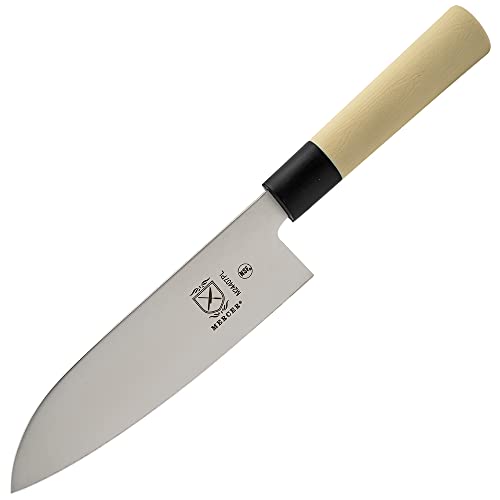
Mercer’s Asian Collection is the restaurant-supply maker’s line of Japanese-shaped knives, and this version of its santoku has an NSF-certified handle. NSF certification is the sanitation standard commercial kitchens buy to, and it tells you the handle is made to be cleaned and sanitized repeatedly. According to the listing, the handle is slip-resistant Santoprene.
The blade is high-carbon, stain-free German steel. The listing is not fully consistent about the edge: one line describes a taper grind “to form a single blade edge,” while the feature list says it is a double-edge blade with a 16-degree edge on both sides. The more specific line, 16 degrees on both sides, describes a normal double-bevel knife that works for right- and left-handed cooks, but check with the seller if a single bevel matters to you.
Mercer asks for hand washing with warm water and mild soap and says to keep it out of the dishwasher. The listing mentions a limited lifetime warranty.
Why we like it
- NSF certified, per the listing.
- Slip-resistant Santoprene handle.
- 16-degree edge on each side, per the feature list.
- Limited lifetime warranty.
Key specifications
| Model | M24407PL |
|---|---|
| Blade length | 7 in |
| Edge | Plain, 16° per side |
| Steel | High-carbon stain-free German steel |
| Construction | Not stated |
| Handle | Santoprene, NSF certified |
| Care | Hand wash; not dishwasher safe |
| Made in | Not stated |
Why we recommend it
It suits cooks who want a plain, hard-working knife built to restaurant sanitation standards, and who like a grippy handle more than a handsome one.
Skip it if you need a knife that can go in the dishwasher; Mercer says this one cannot.
Pros and cons
Pros
- NSF-certified handle
- Grippy when wet
- Stated edge angle
Cons
- Listing is inconsistent about the bevel
- Hand wash only
7. Cuisinart Graphix 7-inch Santoku – Tapered Blade, Textured Grip

Cuisinart sells its knives alongside its appliances and cookware, and the Graphix collection is one of its single-knife lines. The listing describes a high-carbon stainless steel blade, precision-tapered so that it narrows gradually to a fine edge, and a textured handle for a comfortable grip. The listing title calls it a stainless steel knife, and the Graphix range is sold as a sleek all-steel design.
What you do not get is much detail. The listing does not give care instructions, the country of manufacture or how the blade is made. What it does give is a lifetime warranty, which is the most useful single fact on a budget knife listing because it shows the maker expects the knife to last.
A steel handle looks clean and is easy to wipe, but it can feel slippery and cold compared with a rubbery handle, which is why Cuisinart adds the texture. If you can, hold one before you buy.
Why we like it
- Precision-tapered blade for a fine edge, per the listing.
- Textured handle for grip.
- Lifetime warranty.
Key specifications
| Model | C77SS-7SAN |
|---|---|
| Blade length | 7 in |
| Edge | Plain, tapered |
| Steel | High-carbon stainless steel |
| Construction | Not stated |
| Handle | Textured (stainless steel per title) |
| Care | Not stated |
| Made in | Not stated |
Why we recommend it
It suits a cook who wants a modern, easy-to-wipe santoku from a familiar kitchen brand and is happy with a simple knife for occasional use.
Skip it if you cook every day; the thin listing gives no care or construction details, and a steel handle is less forgiving with wet or oily hands.
Pros and cons
Pros
- Lifetime warranty
- Tapered blade for a fine edge
- Easy-to-wipe design
Cons
- Care, origin and construction not stated
- Steel handle can feel slippery
8. imarku 7-inch Santoku – Hollow Edge and Pakkawood Handle
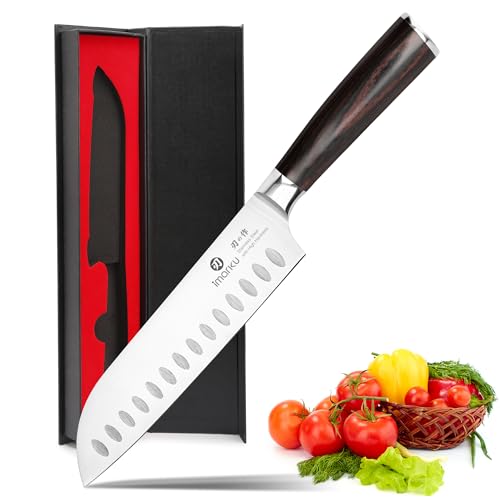
imarku is a brand that sells mainly on Amazon, and this 7-inch santoku is one of its best-known knives. Unlike most of the makers here, imarku gives numbers: the listing says the blade is 2.5 mm thick, sharpened to 15 to 18 degrees per side, and made from Japanese high-carbon stainless steel that resists rust, corrosion and discoloration. The side of the blade has a scalloped hollow edge to keep slices from sticking.
The handle is Pakkawood, a resin-impregnated wood laminate, and imarku says its version is more stable than traditional wood and will not swell or crack. The knife comes in a black gift box, which is part of why it is a popular present.
Two things to weigh. imarku’s support terms are a 3-month refund and a 1-year exchange rather than the lifetime warranties several makers above offer. And the listing warns that the brand is updating its products and packaging, so the knife you receive may look different from the photos, though imarku says the materials and construction are identical.
Why we like it
- Stated thickness and edge angle, per the listing.
- Hollow edge to reduce sticking.
- Pakkawood handle.
- Gift box included.
Key specifications
| Model | I-KSK0064DB |
|---|---|
| Blade length | 7 in |
| Edge | Hollow edge, 15–18° per side |
| Steel | Japanese high-carbon stainless steel |
| Construction | Not stated (2.5 mm blade) |
| Handle | Pakkawood |
| Care | Not stated |
| Made in | Not stated |
Why we recommend it
It suits someone buying a santoku as a gift, or a cook who likes a wood-look handle and wants clear numbers on edge angle and thickness.
Skip it if a long warranty matters to you; the 1-year exchange is short next to Victorinox, Mercer and Henckels.
Pros and cons
Pros
- Clear edge-angle and thickness figures
- Hollow edge
- Comes gift-boxed
Cons
- Short refund and exchange terms
- Product and packaging may differ from photos
How to judge value in a budget santoku
We do not print prices because they change week to week, and a knife that looks cheap today may be on sale for less tomorrow. A better question is what you are paying for. Most of the cost difference between an entry-level santoku and a premium one comes from four places.
Stamped or forged. A stamped blade is cut from a sheet of steel, a forged one is hammered from a thick blank. Stamping is cheaper and gives a lighter, thinner knife, which many cooks prefer for a santoku. Forging gives weight and a bolster. Neither is better for chopping onions; it is a matter of feel.
The handle. Plastic, polypropylene and Santoprene handles cost less than wood or Pakkawood and stand up better to water. Commercial kitchens use them for that reason.
The steel. Entry-level knives use softer stainless steels that are easy to sharpen at home and forgiving if you hit a bone or a hard pit. Pricier knives use harder steel that holds an edge longer but can chip. For a home cook who hones regularly, softer steel is not a real loss.
The fit and finish. Polished spines, Damascus patterns and fancy bolsters cost money and do nothing for the cut.
Where a budget knife should not cut corners: it should come sharp, have a handle that stays put when wet, come from a maker you can identify and, ideally, carry a real warranty. Every knife on this page meets the first three; most meet all four.
How to choose a cheap santoku knife
1. Blade length
Seven inches is the standard all-purpose size and handles a whole onion or a head of lettuce. Five to 6.5 inches suits small hands, small boards and detail work. If this is your only knife, buy 6.5 to 7 inches.
2. Plain or fluted edge
Fluted, granton or hollow edges have scallops along the side that help sliced potatoes and cucumbers fall away. They help a little and cost nothing extra here. A plain blade is just as good for chopping and slightly easier to sharpen to the heel.
3. Dishwasher or hand wash
Victorinox and Henckels say their knives on this page can go in the dishwasher; Mercer and Wüsthof say theirs cannot. Hand washing is kinder to any edge, but buy the knife that matches how your kitchen really works.
4. Handle and weight
Light stamped knives with slim handles suit quick, precise chopping. Forged knives with bolsters suit cooks who like the blade to do some of the work. Grippy rubber-like handles are the safest choice for cooks with wet or oily hands.
5. Warranty and sharpening support
A lifetime warranty or, in Kai’s case, free sharpening is worth more than any feature on the box. A cheap knife that is kept sharp beats an expensive one left dull.
How we picked these eight budget santokus
We started with what a santoku has to do in a working kitchen: chop vegetables and herbs quickly, slice cleanly, feel secure in a wet hand and be easy to keep sharp. We then looked only at knives in stock on Amazon in the United States from established, identifiable makers, and only at the entry tier of each maker’s range. For each knife we read the Amazon listing for the blade, edge, construction, handle, care and warranty, and used America’s Test Kitchen’s published santoku knife review for its findings on the Mercer Genesis. We left out every knife already recommended on our best santoku knife and best Japanese santoku knife guides, including Victorinox’s Fibrox and Mercer’s Millennia santokus, and knives from our knife-set and beginner pages. We also left out Tojiro’s basic santoku, whose listing gives too little information to recommend, knives that were back-ordered or listed as scarce, Global and Mac (not budget knives), and sellers with no identifiable maker; imarku is the one Amazon-first brand here. We checked the U.S. Consumer Product Safety Commission’s recall database for each brand on this page and found no kitchen knife recalls. We have not used these knives ourselves; where we describe how a knife performs, we say whose findings those are.
Budget santoku questions, answered
What is the best value santoku knife?
For most cooks, the Victorinox Swiss Classic 7-inch: it is Swiss made, dishwasher safe according to Victorinox and comes from a maker trusted in professional kitchens. The Kai Wasabi is the better value if you will use Kai’s free sharpening.
Is an inexpensive santoku knife worth buying?
Yes, if it comes from an identifiable maker and you keep it sharp. Entry-level santokus give up weight, fancy handles and edge retention, not the ability to chop well. Pair one with a honing steel and it will serve for years.
What should I look for in a santoku on a budget?
A 6.5- to 7-inch blade, a handle that stays put when wet, clear care instructions and a warranty. A fluted or hollow edge is a small bonus. Avoid listings with no identifiable maker.
Is a santoku better than a chef’s knife for a beginner?
It is easier for some beginners because the flat edge chops straight down instead of rocking. Others prefer the longer reach of a chef’s knife. Our guide to the best chef knife for beginners covers the other option.
How do I keep a cheap santoku sharp?
Hone it every few uses, wash and dry it by hand when you can, cut on wood or plastic rather than glass or stone, and sharpen it a few times a year. Our best knife sharpener guide covers the tools that suit these softer steels.
Our final pick for everyday chopping
Buy the Victorinox Swiss Classic 7-inch Granton Santoku if you want one dependable, easy-care knife and no fuss. Choose the Kai Wasabi for a lighter Japanese-style blade with free sharpening, or the Mercer Genesis if you like a forged knife with some weight behind it.
If you are ready to spend more, our main guide to the best santoku knife covers step-up knives, and the best Japanese santoku knife guide covers made-in-Japan blades. If you mostly cut vegetables, the squared-off nakiri knife is worth a look too.
And if you would rather someone else did the chopping tonight, see the menu or call to order.