
Every cook has a recipe that worked once and never again. The beans stayed hard, the sauce split, the steak turned gray. A recipe rarely tells you why, and that is the gap a food science book fills. Once you know what heat, salt and acid actually do, you can fix a dish, adapt it and stop guessing. Mexican cooking already runs on this kind of chemistry: nixtamalization, the lime treatment that turns corn into masa, is one of the oldest food science tricks there is.
Books on the subject range from friendly seasoning guides to university texts, so the right one depends on how you want to learn. This guide picks eight by named authors from established publishers, from a Harvard class to a question-and-answer read for the couch. It sets out what the publisher and named reviewers say about each, and says plainly where a pick rests on publisher details alone.
Julia’s earns a commission on purchases made through links on this page, at no cost to you. Recommendations are based on what a restaurant kitchen looks for in a book, publisher information and published reviews, which we name.
Quick verdict: the best food science book to start with
For most home cooks, start with Harold McGee’s Keys to Good Cooking: practical science that works alongside any recipe you already own. If you want to cook by proportion instead of by recipe, choose Michael Ruhlman’s Ratio. If you want recipes with the science built in, choose Nik Sharma’s The Flavor Equation.
The other five cover ingredients one at a time, a Harvard class on physics and food, an easy question-and-answer read, the book that named molecular gastronomy, and the chemistry of spice blends.
Five cooking science books side by side
Five of the eight, one for each kind of reader, with the details each publisher or listing gives. All eight are described in full below.
| Book | Best for | Recipes | Length | Buy on Amazon |
|---|---|---|---|---|

Keys to Good Cooking, Harold McGeeBest overall
|
Quick answers while you cook | Not a recipe book | 576 pages, paperback | View on Amazon |

Ratio, Michael RuhlmanBest for learning to cook
|
Cooking by proportion, not recipe | Base ratios; count not stated | 272 pages, paperback | View on Amazon |

Cook’s Science, America’s Test KitchenBest by ingredient
|
Understanding one ingredient at a time | Recipes included; count not stated | 504 pages, hardcover | View on Amazon |
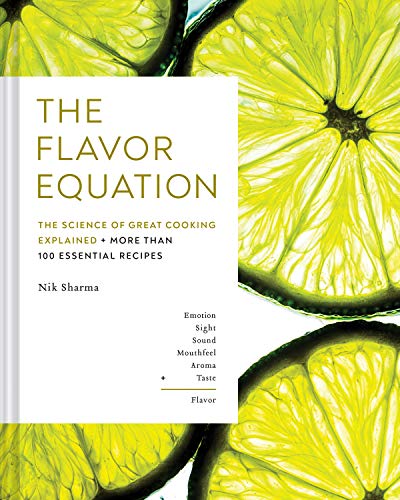
The Flavor Equation, Nik SharmaBest with recipes
|
Science plus cooking from around the world | More than 100 (subtitle) | 352 pages, hardcover | View on Amazon |

Science and Cooking, Michael Brenner, Pia Sörensen and David WeitzBest for real physics
|
The physics and chemistry behind recipes | Recipes and experiments | 320 pages, hardcover | View on Amazon |
Cover images from Amazon. Page counts and formats are from the publisher or the Amazon listing for the edition linked; other sources may differ.
Our picks for the best food science book, title by title
These eight run from the easiest to the most demanding in roughly the order a curious cook might want them. For each we give what the publisher, the listing and any named review say. We have not worked through every recipe or experiment here; where we describe a strength, we say whose view it is. Seven picks have named reviews or press behind them. The Science of Spice rests on publisher and author details.
1. Keys to Good Cooking, Harold McGee – Kitchen Science You Can Use Tonight
Harold McGee is the name most cooks reach for first on this subject. Penguin calls him a widely recognized authority on the chemistry of food and cooking, and he studied science and literature at Caltech and Yale. His bigger book, On Food and Cooking, was not available as a plain in-stock new copy when we checked, so this is the McGee we can recommend today, and for most home cooks it may be the better one to keep near the stove.
The publisher describes a guide meant to sit next to your recipe books: it helps you judge a recipe, fix a flawed one and get the most from it, turning modern cooking science into practical advice on choosing, preparing and serving a wide range of foods. It is written for cooks at every level.
The Wall Street Journal said it “offers indispensable information on how to make the most of any recipe,” and Seattle Weekly called it “A great addition to any cookbook library,” both as quoted by Penguin. Publishers Weekly, also as quoted there, said McGee “will banish any romantic notions about cooking.”
Why we like it
- By the author of On Food and Cooking
- Works alongside any recipe book
- Named praise from The Wall Street Journal, as quoted by Penguin
- Written for cooks at every level
Key specifications
| Author | Harold McGee |
|---|---|
| Publisher | Penguin Books |
| Year | 2012 paperback |
| Pages | 576 |
| Format | Paperback |
| Recipes | None; a guide, not a recipe book |
| Focus | Practical science for any recipe |
| Best for | Cooks who want quick, reliable answers |
Why we recommend it
If you want one book that explains why a recipe works and how to rescue it when it does not, this is the pick. You can look up a single food in a minute, which is how most of us use a reference.
Skip it if you want recipes. It is a companion to your cookbooks, not a replacement, and Sharma or Ruhlman will give you dishes to cook.
Pros and cons
Pros
- From the leading name in kitchen science
- Practical, not academic
- Useful with every cookbook you own
Cons
- No recipes of its own
- Less depth than McGee’s larger book
2. Ratio, Michael Ruhlman – The Proportions Behind Everyday Cooking
This is a cooking book with the reasoning built in rather than a chemistry text. Michael Ruhlman’s idea is that most basic preparations rest on a fixed proportion of ingredients by weight, and that once you know the proportion you no longer need the recipe. Barnes & Noble’s description puts it plainly: the book “is not about recipes but rather about basic ratios and fundamental techniques,” and “knowing a culinary ratio is not like knowing a single recipe; it’s instantly knowing a thousand.”
Michael Nagrant’s review, first published in the Chicago Sun-Times, names batters, cakes, breads, cookie dough, cream puff dough and hollandaise among its subjects, with the bread ratio of five parts flour to three parts liquid on the cover. He called it a modern culinary textbook and wrote that it “really works because of its elasticity.” Barnes & Noble calls it a New York Times bestseller. The listing gives 272 pages in a 2010 paperback from Simon & Schuster.
For a Mexican kitchen the habit is the useful part: weighing masa and water, flour and lard for tortillas de harina, or eggs and milk for a flan, so a batch scales up or down without guessing. Ratios are about weight, so you will want a kitchen scale.
Why we like it
- Teaches proportions, not single recipes
- NYT bestseller, per Barnes & Noble
- Short enough to read through
- Works by weight, so it scales
Key specifications
| Author | Michael Ruhlman |
|---|---|
| Publisher | Simon & Schuster |
| Year | 2010 paperback |
| Pages | 272 (listing) |
| Format | Paperback |
| Recipes | Built on base ratios; count not stated here |
| Focus | Ingredient proportions and technique |
| Best for | Cooks who want to stop relying on recipes |
Why we recommend it
If you want to cook without a recipe in front of you, start here. It teaches a way of thinking about a dish that carries over to any cuisine, including ours.
Skip it if you want the chemistry. It tells you what proportion works, not what the molecules are doing.
Pros and cons
Pros
- Very practical
- Short and readable
- Scales to any batch
Cons
- Little chemistry
- Weighted toward baking and sauces
- You need a scale

3. Cook’s Science, America’s Test Kitchen – Fifty Ingredients, Explained
Instead of working through techniques, this book works through the pantry. Publishers Weekly describes a guide to 50 common ingredients, covering questions such as how slaughter affects the flavor of meat, how smoke gets into food, and how to choose onions and orange juice.
The editors at America’s Test Kitchen pair the science with recipes, and PW singles out a roasted tomato sauce, a cheese soufflé and a surprisingly simple honey fried chicken, along with sections on pantry staples, lobster, kale and melting cheese. Guy Crosby, who holds a PhD, is credited on the listing as an editor, and the listing calls it a companion to The Science of Good Cooking, which was in short supply when we checked.
PW’s verdict was that it is “a solid resource as well as a foundation to build from.” One buying note: when we checked, the new copy was offered by a third-party seller on Amazon, not by Amazon itself, so read the offer before you buy.
Why we like it
- PW called it a solid resource
- Built around 50 familiar ingredients
- Recipes that apply the science
- America’s Test Kitchen is an established name in home cooking
Key specifications
| Author | Editors of America’s Test Kitchen and Cook’s Illustrated, with Guy Crosby |
|---|---|
| Publisher | America’s Test Kitchen |
| Year | 2016 |
| Pages | 504 |
| Format | Hardcover |
| Recipes | Included; count not stated |
| Focus | The science of 50 ingredients |
| Best for | Cooks who shop and think by ingredient |
Why we recommend it
If your questions start with an ingredient (why this onion, why this cut), this is laid out the way you already think. It also gives you recipes, so the reading turns into dinner.
Skip it if you want a Mexican pantry guide. PW describes 50 common ingredients. Our guide to Mexican pantry staples covers that ground.
Pros and cons
Pros
- Easy to dip into
- Reviewed directly by PW
- Science and recipes together
Cons
- Sold by a third party when we checked
- Heavy hardcover
4. The Flavor Equation, Nik Sharma – Why Flavor Works, With Recipes
Nik Sharma is a bestselling cookbook author, and this book is his account of why flavor works. The Amazon listing describes an in-depth exploration of the science of taste and a look at the most basic pantry items: salts, oils, sugars, vinegars, citrus and peppers. The subtitle promises more than 100 recipes, and Christopher Kimball wrote the foreword.
Chronicle Books lists it as a finalist for the 2022 James Beard Cookbook Award and a 2021 IACP Cookbook Award finalist, and says The New York Times named it among its best fall cookbooks of 2020. We read those details through search results, since the publisher’s page would not load for us. Writing in Milk Street’s book reviews, Kimball said it is not a book for geeks who want a deep dive into amino acids and osmosis, and for most home cooks that is a recommendation.
Peppers and citrus are at the center of a Mexican kitchen, so this is one of the more relevant books here for us. Publishers Weekly has no review of it, so the case rests on the awards, the author and the publisher’s details.
Why we like it
- James Beard Award finalist, per Chronicle
- More than 100 recipes, per the subtitle
- Covers salts, oils, sugars, vinegars, citrus and peppers
- Global recipes
Key specifications
| Author | Nik Sharma (foreword by Christopher Kimball) |
|---|---|
| Publisher | Chronicle Books |
| Year | 2020 |
| Pages | 352 |
| Format | Hardcover |
| Recipes | More than 100 (subtitle) |
| Focus | Flavor science through recipes |
| Best for | Cooks who want to learn while cooking dinner |
Why we recommend it
If you learn best by cooking, not reading, this is the most useful book here. You get the reasoning and a recipe that shows it in the same sitting. For peppers themselves, see our guide to Mexican chiles.
Skip it if you want a pure reference. It is arranged to be read and cooked from, not looked up quickly.
Pros and cons
Pros
- Recipes and reasoning together
- Global palate
- Strong award record
Cons
- No direct PW review
- Less technical than the Harvard book
5. Science and Cooking, Michael Brenner, Pia Sörensen and David Weitz – A Harvard Class in Book Form
This one comes from the classroom. W. W. Norton says it is based on a popular Harvard and edX class, written by three Harvard professors, with introductions by chefs Ferran Adrià and José Andrés. It explains kneading bread, steak temperatures, chocolate chip cookies, pressure and boiling points in pecan praline, and microbes in coffee.
Publishers Weekly reports that the authors themselves say it is “ultimately not a cookbook,” though recipes illustrate each principle. PW gives examples such as measuring the viscosity of cheese sauce and the role of hydrocolloid polymers in Chinese soup dumplings, along with practical tips like using sugar’s melting point to calibrate an oven and keeping pesto from browning.
PW concluded that it suits science enthusiasts who cook and cooks who want to learn the science behind their food. Expect real concepts and some numbers. If high school chemistry was not your favorite, one of the gentler books above will serve you better.
Why we like it
- Based on a Harvard and edX class, per Norton
- Introductions by Ferran Adrià and José Andrés
- Reviewed by PW
- Experiments as well as recipes
Key specifications
| Author | Michael Brenner, Pia Sörensen and David Weitz |
|---|---|
| Publisher | W. W. Norton |
| Year | 2020 |
| Pages | 320 (listing); PW lists 304 |
| Format | Hardcover |
| Recipes | Recipes included; count not stated |
| Focus | Physics and chemistry through food |
| Best for | Readers who want the science itself |
Why we recommend it
If you want to learn the actual science and enjoy working through a concept, this is the most rigorous book for a general reader here.
Skip it if you want dinner ideas. By the authors’ own account, it is not a cookbook.
Pros and cons
Pros
- The most scientific book for general readers here
- Clear, memorable examples, per PW
- Practical tips along the way
Cons
- Takes concentration
- Page count differs by source
6. What Einstein Told His Cook, Robert L. Wolke – Kitchen Questions, Plainly Answered

Robert L. Wolke is a longtime chemistry professor who wrote the “Food 101” column for The Washington Post, Norton notes, and this book keeps that column’s format: a question, then a straight answer. Is sea salt different from supermarket salt? How is sugar made? Should you avoid aluminum pans? Recipes appear along the way to show the principle.
Publishers Weekly’s review praised him for debunking half-truths, such as the claim that sea salt is healthier for sodium-conscious eaters, and said he “tells it like it is.” It also warned that the tone can be corny and that the technical asides may seem condescending to readers who remember high school science. Fair warning, then, but PW’s conclusion was that the book helps cooks make smarter choices.
Mark Bittman called it “as good a read on the science of cooking as there is,” as quoted by the publisher, and it was a finalist for James Beard and IACP awards, Norton says. It is the oldest popular title on this list, so read it for the principles.
Why we like it
- Question-and-answer format
- PW: helps cooks make smarter choices
- James Beard and IACP finalist, per Norton
- Written by a chemistry professor
Key specifications
| Author | Robert L. Wolke |
|---|---|
| Publisher | W. W. Norton |
| Year | 2008 paperback |
| Pages | 368 |
| Format | Paperback |
| Recipes | Some, used to show principles; count not stated |
| Focus | Food chemistry, question by question |
| Best for | Curious readers and gift buyers |
Why we recommend it
If you want something to read on the couch, not at the counter, this is the one. You can pick it up for five minutes and learn something you will repeat at dinner.
Skip it if corny humor wears on you. PW flagged the tone, and the book is not a systematic reference.
Pros and cons
Pros
- Very easy to read in short bursts
- Punctures kitchen myths
- Honest, plain answers
Cons
- Tone can be corny, per PW
- Not organized as a reference
7. Molecular Gastronomy, Hervé This – The Scientist Who Named the Field

Hervé This is a physical chemist in Paris and a co-founder of molecular gastronomy, says Columbia University Press. Here he uses laboratory methods and food research to question common kitchen rules, explain the physiology of flavor and look at the makeup of foods such as bread, ham and champagne.
Publishers Weekly explains the form: short chapters that each take a piece of conventional wisdom, trace its history and give a scientific verdict, for example on whether to add meat to boiling or cold water when making stock. It also warns that many topics are irrelevant to most readers or specific to French cooking, such as quenelles and fondue, and that the experiments are not for casual readers.
Named praise is easy to find on the publisher’s page. The Economist called it a “captivating little book,” and Gourmet said This “is changing the way France—and the world—cooks.” Read it as a curious person’s book about ideas, not a kitchen manual.
Why we like it
- By a co-founder of the field, per the publisher
- Short chapters that test kitchen wisdom
- Praised by The Economist and Gourmet
- Published by a university press
Key specifications
| Author | Hervé This (translated by M. B. DeBevoise) |
|---|---|
| Publisher | Columbia University Press |
| Year | 2008 paperback |
| Pages | 392 (publisher); listing shows 377 |
| Format | Paperback |
| Recipes | None; a science book |
| Focus | Testing cooking rules with science |
| Best for | Readers who already love the subject |
Why we recommend it
If the other books on this page leave you wanting to know how the science got started, this takes you there. It suits a serious reader or a working cook curious about where modern technique came from.
Skip it if you are new to the subject. PW found much of it specific to French cooking, and it won’t help with tonight’s dinner.
Pros and cons
Pros
- Original source for the field
- Challenges kitchen habits
- Short, self-contained chapters
Cons
- French focus, per PW
- Experiments are not for casual readers
8. The Science of Spice, Dr. Stuart Farrimond – A Periodic Table for Your Pantry

Spices do a lot of work in a Mexican kitchen, and this is the one book here that treats them as the main subject. DK’s guide starts from what it calls the periodic table of spices and explains the science behind spice blends, with color-coded charts of flavor compounds and instructions for designing your own.
The publisher also promises a reference guide to individual spices, an explanation of how they are produced and which countries favor which, dozens of blends and 52 recipes from around the world. It is pitched at curious cooks and beginners alike, and it is laid out to look good on a coffee table.
Dr. Stuart Farrimond specializes in food science and works as a science and medical writer and presenter, according to DK, and his writing has appeared in New Scientist. This pick rests on those publisher and author details; Publishers Weekly has no review of it.
Why we like it
- 52 recipes, per DK
- Color-coded charts of flavor compounds
- Shows how to design your own blends
- Reference guide to individual spices
Key specifications
| Author | Dr. Stuart Farrimond |
|---|---|
| Publisher | DK |
| Year | 2018 |
| Pages | 224 |
| Format | Hardcover |
| Recipes | 52 |
| Focus | The chemistry of spices and blends |
| Best for | Cooks who build their own seasonings |
Why we recommend it
If you mix your own chili powders and rubs, this explains why some combinations work. It is the most visual book here, and one a beginner can enjoy without any science background.
Skip it if you want a general kitchen science book. It only covers spices.
Pros and cons
Pros
- Very visual
- Directly useful for seasoning
- Good for beginners
Cons
- Spices only
- Rests on publisher details, not a named review
How to choose a cooking science book
Four questions will narrow these down quickly. Start with how you like to learn, then be honest about how much science you want.
1. Reference, reader or cookbook
Some of these you look things up in, some you read and some you cook from. Keys to Good Cooking and Cook’s Science work as references. What Einstein Told His Cook is for reading. The Flavor Equation and Ratio are for cooking.
2. How much science you want
Ruhlman uses almost no chemistry. McGee and Sharma use it when it helps. Brenner, Sörensen and Weitz teach it, and This questions it. Pick the level you will actually finish; a book that stays on the shelf teaches nothing.
3. Whether it fits how you cook
Science carries across cuisines, but examples do not always. Molecular Gastronomy leans French, and Cook’s Science sticks to common ingredients. For peppers, citrus and spice, The Flavor Equation and The Science of Spice are closest to a Mexican pantry. Our guide to Mexican cooking methods shows where these ideas meet the comal and the pot.
4. What tools you have
Kitchen science rewards measuring. Salt and flour are far easier to control by weight, so a kitchen scale is worth owning, and a meat thermometer will show you what these books mean about doneness. For the wider kit, see Mexican cooking tools.
How we chose these eight food science books
We looked for books a working kitchen would respect: written by named scientists, chefs and food writers at established trade or university publishers, and useful to a home cook. We searched Amazon’s book listings and kept only new print copies in stock when we checked, then took the facts from publisher pages, Publishers Weekly and the reviews publishers quote. Publishers Weekly reviewed Cook’s Science, Science and Cooking, What Einstein Told His Cook and Molecular Gastronomy, and we read those reviews directly. Keys to Good Cooking is backed by press quoted by its publisher, and The Flavor Equation by the award and list details its publisher gives and a Milk Street review. The Science of Spice rests on the publisher’s and author’s details, and Ratio on its listing, Barnes & Noble’s description and Michael Nagrant’s review. Salt, Fat, Acid, Heat was on this list until its hardcover went to back-order. Some famous titles, including On Food and Cooking, The Science of Good Cooking, The Science of Cooking by Stuart Farrimond, Cooking for Geeks and CookWise, were not plainly in stock as new copies when we checked, so they are not on this list. We have not cooked from these books ourselves.
Food science book questions, answered
What is the best cooking science book for beginners?
Ratio if you want to cook better without a recipe, or What Einstein Told His Cook if you want to understand your kitchen in short, easy pieces. Neither needs a science background.
Why isn’t On Food and Cooking on this list?
It is a famous reference, but the print copies we found were not plainly in stock as new books when we checked. Keys to Good Cooking, by the same author, was. If you can find On Food and Cooking new, it is the larger companion.
Which of these has the most recipes?
The Flavor Equation promises more than 100, and The Science of Spice has 52. Keys to Good Cooking and Molecular Gastronomy are not recipe books.
Which book is best for a science student?
Science and Cooking, which grew out of a Harvard class, or Molecular Gastronomy for a more advanced and French-focused view.
Do any of these explain Mexican cooking?
None is a Mexican book, though the ideas apply. For the chemistry of masa, read our page on what nixtamalization is, and for recipes, see the best Mexican cookbooks.
Our final pick for the curious cook
Buy Keys to Good Cooking if you want one practical reference. Choose Ratio to cook by proportion, The Flavor Equation to learn while cooking and Cook’s Science to think by ingredient. Science and Cooking, What Einstein Told His Cook, Molecular Gastronomy and The Science of Spice are for going further. When you are ready to put it to work on a Mexican dish, start with the best Mexican cookbooks.
Related guide: Best food history book.
Related guide: Best food memoir.
And if you would rather let someone else handle the chemistry tonight, see the menu or call to order.