Everyone who cooks well started by burning something. What helps most at the beginning is a book that explains the things experienced cooks take for granted: how hot is medium, what done looks like, and why the onions come first.
Plenty of cookbooks claim to do that, and many of the ones sold for beginners are thin and self-published. This page sets out nine in-stock print books from named authors and established publishers, says which have a published review and which rest on publisher details, and helps you find the best cookbook for beginners who learn the way you do.
Julia’s earns a commission on purchases made through links on this page, at no cost to you. Recommendations are based on what a restaurant kitchen looks for in a teaching cookbook, publisher and author information and published reviews, which we name.
Quick verdict: which beginner cookbook to buy
The best cookbook for beginners who really want to learn is Sohla El-Waylly’s Start Here, a James Beard Award winner that Publishers Weekly calls an ideal handbook for beginners. If you would rather learn while making dinner, choose Molly Baz’s Cook This Book. If you have truly never cooked, choose Betty Crocker Cooking Basics.
The rest of this page explains why, and how far the evidence goes for each. Four of the nine have a Publishers Weekly review, and the others rest on publisher, listing and author details. Each entry says which.
Five beginner cookbooks side by side
Five books, one for each way of learning, with details from each listing, publisher or review. All nine are described in full below.
| Book | Best for | Recipes | Length | Buy on Amazon |
|---|---|---|---|---|

Start Here, Sohla El-WayllyBest overall
|
Learning to cook properly | More than 200 | 656 pages, hardcover | View on Amazon |

Cook This Book, Molly BazBest for learning by doing
|
Confident cooks in the making | 95 | 304 pages, hardcover | View on Amazon |

Betty Crocker Cooking BasicsBest for first-timers
|
People who have never cooked | 112 | 288 pages, spiral hardcover | View on Amazon |

The New Cooking School Cookbook: Fundamentals, America’s Test KitchenBest structured course
|
Learning in a set order | About 400, per booksellers | 680 pages, hardcover | View on Amazon |
How to Cook Everything, Mark BittmanBest reference
|
One book for every question | Not stated | 960 pages, hardcover | View on Amazon |
Cover images from Amazon. Page counts and formats are for the editions linked; other editions differ.
Our picks for the best cookbook for beginners, one by one
The nine are in order of how well they suit a new cook, not how good they are in general. We have not cooked from these books. Where we describe a strength, we say whose view that is.
1. Start Here, Sohla El-Waylly – Learn Why Food Works
This is the book we would hand to someone who wants to learn to cook and not just follow directions. It teaches technique and the reason behind each technique, and that is what lets you cook without a recipe in the end.
Knopf published it in 2023 as a 656-page hardcover, and the listing’s title marks it as a James Beard Award winner. Samin Nosrat wrote the foreword, per the listing. The subtitle promises more than 200 recipes and techniques for cooking with creativity and confidence.
Publishers Weekly reviewed it in November 2023 and described her thorough debut, which teaches “foundational techniques and basic food science.” The reviewer liked that it explains why each step matters, praised the low-fuss recipes and pointed to its advice on tools and on planning a meal. The verdict was that it is an ideal handbook for beginners.
Be realistic about the size. This is a thick book, and it asks you to read as well as cook. If you only want dinner tonight, a shorter book below will get you there faster. But if you stick with it, this one should last.
Why we like it
- Publishers Weekly calls it ideal for beginners
- James Beard Award winner, per the listing
- More than 200 recipes and techniques, per its subtitle
- Explains why, not only how
Key specifications
| Author | Sohla El-Waylly, foreword by Samin Nosrat |
|---|---|
| Publisher | Knopf |
| Year | 2023 |
| Pages | 656 |
| Format | Hardcover |
| Recipes | More than 200 |
| Focus | Technique and food science for home cooks |
| Best for | Beginners who want real skills |
Why we recommend it
It suits the beginner who is curious and patient, and it should still be useful years from now, when you no longer count as one.
Skip it if you want quick dinners and little reading. This is a course more than a recipe book.
Pros and cons
Pros
- Named review in Publishers Weekly
- Major award, per the listing
- Teaches the reasons behind each method
Cons
- Long and heavy
- More reading than most beginners expect
- Not the fastest route to dinner
2. Cook This Book, Molly Baz – Learn by Cooking Dinner
If Start Here sounds like too much homework, this is the friendlier way in. Clarkson Potter published it in 2021, and the subtitle sums up the plan: techniques that teach and recipes to repeat.
Publishers Weekly reviewed it in December 2020 and described a crash course in cooking fundamentals, with 95 recipes organized by ingredient and a closing section on core techniques. The reviewer singled out the encouraging tone, the charts and checklists, and the QR codes that link to video tutorials. The verdict is plain: “Novice home cooks would do well to have this on the shelf.”
Those video links matter more than they may sound. Many beginners stall on a step they have never seen done, such as how a pan should look before the food goes in. A short video can solve that in a way a paragraph cannot.
At 304 pages, it is about half the length of our top pick, and you can begin with a recipe on the first night and pick up the lessons as you go. It is a modern book in voice and in its tastes, so if you prefer classic American home cooking, try Betty Crocker below.
Why we like it
- Publishers Weekly recommends it for novices
- 95 recipes, per Publishers Weekly
- QR codes link to video tutorials
- Charts and checklists for quick reference
Key specifications
| Author | Molly Baz |
|---|---|
| Publisher | Clarkson Potter |
| Year | 2021 |
| Pages | 304 |
| Format | Hardcover |
| Recipes | 95 |
| Focus | Fundamentals through repeatable recipes |
| Best for | New cooks who want dinner and skills |
Why we recommend it
It suits younger cooks and anyone who learns best by making something good on the first try.
Skip it if you want a reference book for looking things up. It is a course built around a set of recipes.
Pros and cons
Pros
- Named review in Publishers Weekly
- Video help for tricky steps
- Manageable length
Cons
- Recipe list is limited compared with a reference book
- Opinionated voice will not suit everyone
- Video links depend on your phone and online access
3. Betty Crocker Cooking Basics – For Absolute Beginners
The right pick if you cannot yet boil an egg and do not want to be made to feel bad about it. This is the most directly beginner-focused book on the list. The listing’s subtitle reads 112 simple recipes for beginner cooks, and booksellers’ copies of the publisher’s description say it assumes nothing beyond the ability to boil water.
This 288-page second edition dates from 2008. Booksellers describe a color photograph of each finished dish plus how-to photos, tips, variations, notes on kitchen equipment and a guide to cooking terms. Recipes are familiar: the description mentions guacamole, meatloaf and strawberry shortcake.
The binding is a real advantage for this level. A spiral hardcover stays open while you work, so you are not holding the page down with a floury hand.
This pick rests on the publisher’s and listing details. Publishers Weekly’s page shows no review. Keep in mind that it is an older book. It is good for basics that do not change, but less so for today’s tastes, and it will not stretch you for long. Most people will outgrow it and be ready for something like Start Here.
Why we like it
- 112 recipes for beginners, per the listing
- How-to photos, per booksellers’ descriptions
- Spiral binding stays open
- Covers terms and equipment
Key specifications
| Author | Betty Crocker editors |
|---|---|
| Publisher | HarperCollins (first issued by Wiley) |
| Year | 2008 |
| Pages | 288 |
| Format | Spiral hardcover |
| Recipes | 112 |
| Focus | Very first recipes and kitchen skills |
| Best for | Complete beginners |
Why we recommend it
It suits new cooks of any age, including a teenager leaving home, and it makes a good first gift.
Skip it if you can already follow a recipe. You will outgrow this quickly.
Pros and cons
Pros
- Assumes no experience
- Familiar American dishes
- Lies open on the counter
Cons
- Published in 2008
- Rests on listing details
- Short on modern and global dishes
4. The New Cooking School Cookbook: Fundamentals, America’s Test Kitchen – A Course in One Book
If you like to learn in order, with one lesson leading to the next, this is the most school-like book here. America’s Test Kitchen published it in 2021 as a 680-page hardcover, and its title says what it is: a cooking school’s fundamentals, in one volume.
Booksellers’ listings of the publisher’s description give more than 80 themed courses, teaching over 200 skills through about 400 recipes, and one sums up the range as everything from poaching an egg to making pasta from scratch. Page counts vary between listings, so we are using the Amazon figure.
America’s Test Kitchen’s strength is the detail. Its recipes tend to tell you what can go wrong and why, which is reassuring when you do not yet know what done looks like.
This pick rests on the publisher’s reputation and listing details. Publishers Weekly’s page shows no review, and we could not reach America’s Test Kitchen’s own page for it. A companion volume, Advanced Fundamentals, is sold separately, so make sure you buy this one first.
Why we like it
- More than 80 courses, per booksellers’ listings
- Over 200 skills, per the same listings
- From a publisher known for recipe development
- Organized as a sequence of lessons
Key specifications
| Author | America’s Test Kitchen |
|---|---|
| Publisher | America’s Test Kitchen |
| Year | 2021 |
| Pages | 680 |
| Format | Hardcover |
| Recipes | About 400 (per booksellers) |
| Focus | Cooking fundamentals as a course |
| Best for | Methodical learners |
Why we recommend it
It suits people who like structure, follow instructions closely and want to work through a subject from the beginning.
Skip it if you want to cook casually and pick recipes by mood. The course format works best if you follow it.
Pros and cons
Pros
- Clear structure
- Large number of recipes
- Reliable publisher
Cons
- Long and heavy
- Rests on listing details
- No named review to cite
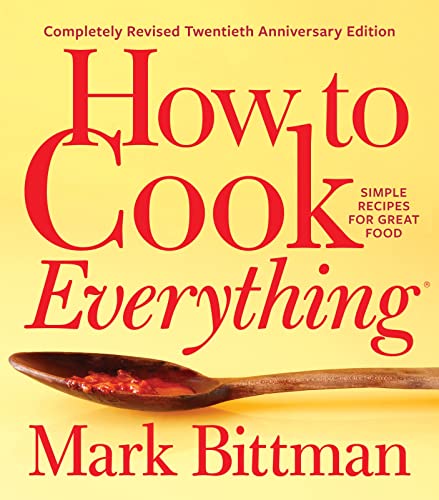
5. How to Cook Everything, Mark Bittman – The Book That Answers Questions
The book to keep on the shelf for the rest of your life. How do you roast a chicken, boil a potato or cook lentils? Bittman has been answering those questions for decades, and this 2019 twentieth anniversary edition is the completely revised version.
The publisher says it is more compact and more focused than earlier editions, adds hundreds of new and reimagined recipes and includes color photos for the first time. The listing gives 960 pages, and the Amazon imprint is Harvest. Bittman’s plain, simple approach to recipes is the reason it suits new cooks despite its size. The vegetarian book in the same series is on our list of vegetarian cookbooks.
This pick rests on the publisher’s details. Publishers Weekly’s page shows no review of this edition. We had hoped to recommend the smaller How to Cook Everything: The Basics, the more obvious beginner’s choice, but it was on back order from a third-party seller when we checked, so it did not qualify.
Think of this as a reference and not a lesson plan. You look something up, cook it, and move on. A book like Start Here teaches you to think about cooking. This one tells you how long to cook the potatoes.
Why we like it
- Completely revised 2019 edition, per the listing
- Color photos for the first time, per the publisher
- Hundreds of new recipes, per the publisher
- Simple, direct style
Key specifications
| Author | Mark Bittman |
|---|---|
| Publisher | Harvest |
| Year | 2019 |
| Pages | 960 |
| Format | Hardcover |
| Recipes | Not stated |
| Focus | General home cooking reference |
| Best for | Cooks who want one big book |
Why we recommend it
It suits anyone setting up a first kitchen who wants one book to go to when a question comes up.
Skip it if you want a guided course. This is organized for looking things up, not for working through.
Pros and cons
Pros
- Covers almost any everyday dish
- Revised and updated
- Useful for years
Cons
- Very large book
- Not paced for a true first-timer
- No named review to cite
6. Martha Stewart’s Cooking School – Photographed Lessons in Classic Technique

Martha Stewart’s name may suggest entertaining, but this book is a teaching manual. Clarkson Potter published it in 2008 as a 512-page hardcover, set out as a series of lessons.
Publishers Weekly reviewed it in August 2008 and called it “an excellent foundation course in cooking techniques.” The reviewer praised its clear instruction, its photos and its “numerous helpful checklists, charts and boxed tips,” and described lessons that move from basics such as roasting a chicken to more advanced work.
The review’s conclusion was that it would be an ideal choice for new cooks and for anyone who wants a reference on technique. Its approach is classic, and it is more formal than Molly Baz’s book, so expect the skills of a traditional kitchen, not weeknight shortcuts.
That is its value. If you want to learn a proper roast chicken from someone who insists on doing things carefully, this will teach you. It is older than most of the books here, but classic technique does not date much.
Why we like it
- Publishers Weekly calls it an excellent foundation course
- Checklists, charts and boxed tips, per the review
- Photographs support the lessons, per the review
- Moves from basics to harder techniques
Key specifications
| Author | Martha Stewart |
|---|---|
| Publisher | Clarkson Potter |
| Year | 2008 |
| Pages | 512 |
| Format | Hardcover |
| Recipes | Not stated |
| Focus | Classic cooking technique, taught as lessons |
| Best for | Careful learners |
Why we recommend it
It suits the beginner who wants to learn things the proper way, one technique at a time.
Skip it if you want fast, casual cooking. This is a book about doing things correctly.
Pros and cons
Pros
- Named review in Publishers Weekly
- Well-illustrated lessons, per the review
- Useful as a later reference
Cons
- Published in 2008
- More formal than most beginners need
- Recipe count not confirmed
7. Cooking Basics For Dummies, Marie Rama and Bryan Miller – Plain Answers in Paperback

The familiar yellow-and-black series is a good fit here, because beginners need things explained without fuss. This is the fifth edition, a 464-page Wiley paperback from 2020.
Bryan Miller is a former New York Times restaurant critic, and Marie Rama is a food writer and recipe developer, according to the book’s listings. So this is a popular format with experienced authors behind it, and that is why it earns a place here despite the series’ simple image.
The book opens with chapters on cooking with confidence and on the essential tools, per its table of contents. A bookseller’s listing adds notes on adapting meals to low-sugar, low-sodium, plant-based and vegetarian diets, and a library record of the earlier edition describes a glossary of common terms and a table of substitutions and equivalents.
This pick rests on the publisher’s details. Publishers Weekly’s page shows no review. It is the most text-heavy book of the beginners’ group, so if you learn better from pictures, pick Betty Crocker instead. But as a plain paperback that answers basic questions, it does the job.
Why we like it
- Fifth edition, per the listing
- Co-written by a former New York Times critic
- Opens with confidence and tools chapters
- Glossary and substitutions, per a library record of the earlier edition
Key specifications
| Author | Marie Rama and Bryan Miller |
|---|---|
| Publisher | Wiley |
| Year | 2020 |
| Pages | 464 |
| Format | Paperback |
| Recipes | Not stated |
| Focus | Basic skills, tools and terms |
| Best for | Beginners who want explanations |
Why we recommend it
It suits new cooks who want to read a clear answer in simple language and are not bothered by a cover that says Dummies.
Skip it if you learn by looking at pictures. This is mostly words.
Pros and cons
Pros
- Clear explanations
- Experienced authors
- Paperback and easy to carry
Cons
- Text-heavy
- Rests on publisher details
- Some readers will dislike the series style
8. The I Don’t Know How To Cook Book, Mary-Lane Kamberg – 300 Recipes That Forgive Mistakes
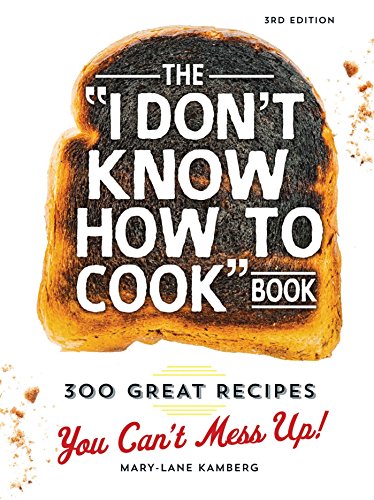
The title speaks directly to the buyer, and the subtitle promises 300 great recipes you can’t mess up. Adams Media published this third edition in 2015 as a 336-page hardcover, per the listing.
Mary-Lane Kamberg is a professional writer, editor and speaker, according to a publisher’s listing, and booksellers describe the book as fool-proof recipes with surefire instructions. The large recipe count in a fairly short book suggests short, direct recipes, not long lessons.
We would judge that promise cautiously, since no book can guarantee a result. What it offers is a simple starting point for someone nervous, and enough recipes to keep going for a while before you need a second book.
This pick rests on the publisher’s and listing details. Publishers Weekly’s page shows no review, and we could not open the publisher’s page itself. It teaches less about why things work than our top picks, so treat it as a confidence builder and not a full education.
Why we like it
- 300 recipes, per the listing’s title
- Third edition, per the listing
- Written for people who say they cannot cook
- Hardcover at a manageable length
Key specifications
| Author | Mary-Lane Kamberg |
|---|---|
| Publisher | Adams Media |
| Year | 2015 |
| Pages | 336 |
| Format | Hardcover |
| Recipes | 300 |
| Focus | Simple everyday recipes |
| Best for | Nervous first-time cooks |
Why we recommend it
It suits people who are put off by long instructions and who just want a recipe they can follow tonight.
Skip it if you want to learn technique. This is about getting dinner made.
Pros and cons
Pros
- Large recipe count
- Written for the true beginner
- Simple starting point
Cons
- Little teaching of why things work
- Rests on listing details
- “Can’t mess up” is a promise, not a fact
9. Joy of Cooking, Rombauer, Becker and Scott – The American Kitchen Classic
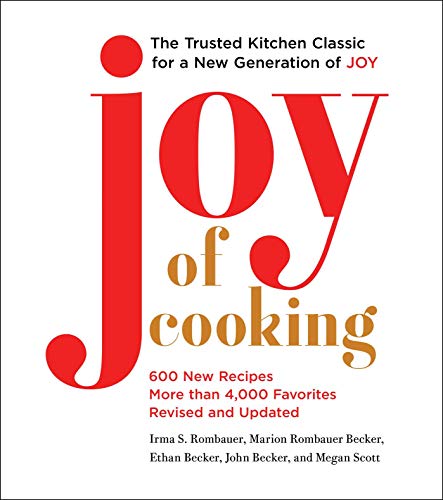
It would be strange to leave out the book that has taught generations of Americans to cook, though it comes last here for a reason. Joy of Cooking is a reference to grow into, not the place to start.
This is the 2019 revision, a 1,200-page hardcover listed under Simon & Schuster, with John Becker and Megan Scott carrying the family book forward. Publishers Weekly reviewed it in September 2019 and said the classic “gets a massive overhaul in this impressive, timely volume,” with more than 4,000 recipes updated and over 600 new ones, including globally inspired dishes.
The review says it keeps the book’s signature format, in which the ingredients are woven into the instructions, adds useful charts and takes in modern tools. It called the result “quite an achievement indeed.”
That signature format is the main reason it is not our first choice for beginners. Ingredients woven through the steps can be harder to follow when everything is new. Buy it if you want a lifelong kitchen companion, and pair it with a true beginner’s book.
Why we like it
- Publishers Weekly praises the 2019 overhaul
- Over 600 new recipes, per the review
- Includes modern tools and global dishes, per the review
- Long-standing American reference
Key specifications
| Author | Irma S. Rombauer, Marion Rombauer Becker, Ethan Becker, John Becker and Megan Scott |
|---|---|
| Publisher | Simon & Schuster (Scribner) |
| Year | 2019 |
| Pages | 1,200 |
| Format | Hardcover |
| Recipes | Over 4,000 updated, 600+ new (per Publishers Weekly) |
| Focus | General American home cooking |
| Best for | Cooks building a lifelong shelf |
Why we recommend it
It suits people who want a single family reference, or who are buying a wedding or graduation gift to last.
Skip it if this is your only cookbook and you are starting from nothing. Its format can be hard for a first-timer.
Pros and cons
Pros
- Named review in Publishers Weekly
- Huge range
- Updated for modern kitchens
Cons
- Very large book
- Ingredient style can confuse new cooks
- Not a course
How to choose a learn-to-cook book
Most first cookbooks fail because they do not match the way the owner wants to learn. These five questions will help you avoid buying one that stays on the shelf.
1. Are you learning to cook, or just trying to get dinner made?
A learn-to-cook book teaches you to work without it in time. Start Here, The New Cooking School Cookbook and Martha Stewart’s Cooking School are built that way. The I Don’t Know How To Cook Book and Betty Crocker Cooking Basics are about getting a good dish on the table. Both are fair goals, but they point to different books.
2. Do you learn from words, pictures or video?
Cook This Book links to videos. Betty Crocker relies on how-to photos. Cooking Basics For Dummies relies on explanation. Look at a few sample pages on Amazon before you buy, because this choice matters more than the recipe list.
3. How much do you want to read?
Page counts here run from 288 to 1,200. A big book is not better if it scares you off. If you are short on time, start with one of the shorter books and add a reference later.
4. What do you like to eat?
You will only learn from food you want to eat. If that is Mexican food, go straight to our list of Mexican cookbooks for beginners. For quick family plans, see meal prep cookbooks. If you are buying for a young cook, our kids’ cookbooks page is a better starting point than anything here.
5. Do you have the basic tools?
A good book will not rescue a dull knife. You do not need much: one sharp knife, a board, a heavy pan and a pot. Start with the best chef’s knife for beginners, keep it sharp with a beginner’s knife sharpener, and add a good cutting board. A cookbook stand also helps keep a big book open and clean.
How we picked these nine beginner cookbooks
We went through the Amazon book listings, kept only print editions that showed plain in-stock status with a new lead offer sold by Amazon, and required a named author or an established editorial brand at an established trade publisher. We left out self-published and AI-looking titles, which crowd this category, and every title on our other book pages, including our list of food science books. Each book had to be written for people who are learning, or be a general reference that new cooks commonly use. How to Cook Everything: The Basics and The New Basics Cookbook were out because they were on back order when we checked, and Delia Smith’s How to Cook volumes were in short supply.
Four picks have a named review, all from Publishers Weekly: Start Here, Cook This Book, Martha Stewart’s Cooking School and Joy of Cooking. The other five rest on publisher, listing and author details, and for those five, Publishers Weekly’s page showed no review. That means only that we are not citing one, not that none exists anywhere. We took formats, dates and page counts from the listings and publishers. We have not cooked from these books, and where we describe a strength we say whose view it is.
Beginner cookbook questions, answered
What is the best first cookbook for someone who has never cooked?
Betty Crocker Cooking Basics, because it is the book here that assumes the least. If that seems too simple, or you want to keep learning for longer, Cook This Book is the next step.
What is the best learn to cook book for adults?
Start Here, if you want to understand cooking, and The New Cooking School Cookbook: Fundamentals, if you prefer a set course. Publishers Weekly calls Start Here an ideal handbook for beginners.
Is Joy of Cooking good for beginners?
It is a good second book. It covers nearly everything, but its long-standing format weaves ingredients into the instructions, which can be harder to follow when you are new. We would pair it with a teaching book.
Do I need more than one cookbook?
Not at first. One teaching book will carry you for months. Add a reference such as How to Cook Everything when you start looking things up, and then a book on food you love, such as those in our list of the best Mexican cookbooks.
Should a beginner choose a book with photos?
It helps. A photo shows you what done looks like, which is the thing new cooks most often cannot judge. Betty Crocker and Martha Stewart’s books both use them to teach, according to their descriptions.
Our final pick for a first cookbook
Buy Start Here if you are serious about learning, Cook This Book if you want something friendlier, and Betty Crocker Cooking Basics if you are starting from nothing. Then get a decent chef’s knife, which will do more for your cooking than a second book. If Mexican food is next, Mexican cooking tools covers the basic kit.
Related guide: Best college cookbook.
Related guide: Best restaurant cookbook.
Related guide: Best america’s test kitchen cookbook.
Related guide: Best cookbooks to give as gifts.
And on the nights when learning can wait, see the menu or call to order.